Four-question support finder
Make every connection earn its place.
Unknown threads and unknown load ratings stop the recommendation. A product appears only after the missing job is specific.
The stability chain
Payload is one link in a five-link system.
A strong tripod can still fail through a loose adapter, jerky head, raised center column, or impossible viewing posture.
Binocular
Loaded weight, balance point, and straight-through or angled eyepieces.
Interface
Exact thread, plate, barrel clearance, and a locked safety catch.
Head
Capacity, counterbalance, smooth altitude motion, and upward range.
Legs
Torsional stiffness and useful height before the last center-column segment.
Observer
Eye height, neck angle, chair position, setup tolerance, and carry distance.
A conservative screening rule
We ask the mount to carry twice the loaded optic.
Manufacturer limits are ceilings, not promises about settling time. Our finder starts with a two-times weight screen, then asks whether the complete system reaches the eye and settles after a light tap.
This is an editorial comparison rule—not structural certification. Wind, extension, imbalance, plate geometry, and manufacturer instructions still control the real setup.
Four different jobs
Do not rank an adapter against a parallelogram.
These are specification-based routes, not a universal top-four list. Prices and stock are deliberately omitted because both change faster than fit.
RSR Binocular Tripod Adapter
A compatible binocular plus an adequate tripod already in the house
- Job
- Adapter-only route
- Capacity
- Not published
- Height
- Not applicable
- Own weight
- 0.5 lb / 227 g
- Interface
- Binocular 1/4-20 socket to standard tripod head or plate
The smallest justified purchase when the legs and head are already stable. Celestron explicitly lists SkyMaster, Echelon, Cavalry, and Cometron families, but exact clearance still needs checking.
Your binocular already includes an adapter, lacks the front-center 1/4-20 socket, or your tripod is the weak link.
We may earn a commission if you buy through this link.
Check current availabilityHummingbird Pan Tilt Tripod
Portable mid-sky sessions with a separately verified binocular adapter
- Job
- Portable complete-tripod route
- Capacity
- 11 lb / 5 kg
- Height
- 23.6–68.9 in / 600–1,750 mm
- Own weight
- 3.86 lb / 1.75 kg
- Interface
- Quick-release plate with 1/4-20 bolt
A comparatively light full tripod with a published five-kilogram load rating and a head that tilts to 90 degrees. Its maximum height must still work for your body and viewing angle.
You are tall, spend long sessions near zenith, need a binocular adapter that is not included, or expect maximum stiffness with the center column fully extended.
We may earn a commission if you buy through this link.
Check current availability4000 Tall Binocular Tripod/Head
Standing astronomy sessions where useful head height matters more than low carry weight
- Job
- Tall astronomy-tripod route
- Capacity
- 11 lb / 5 kg
- Height
- 24–78 in / 61–198 cm
- Own weight
- 9 lb / 4.1 kg
- Interface
- Quick-release plate; optional heavy-duty L adapter
Built around a fluid head and tall stance for binocular astronomy. The extra height is the meaningful upgrade over a general-purpose photo tripod—not a promise that straight-through eyepieces become comfortable at zenith.
Nine pounds is too much to transport, your binocular exceeds the published capacity, or reclined viewing and frequent observer-height changes are the real job.
We may earn a commission if you buy through this link.
Check current availabilityPM2 Parallelogram Mount
Reclined, shared-height, or long high-angle observing
- Job
- Ergonomic premium route
- Capacity
- 2–12 lb / 0.9–5.4 kg
- Height
- 28 in / 71 cm eyepiece-height travel
- Own weight
- 20 lb / 9.1 kg mount only
- Interface
- Quick-release head; matching tripod and adapter path required
The expensive comfort route. It moves eyepiece height without losing the target and can reach a reclining observer when paired with the matching tripod, but the mount alone is heavy and the tripod is extra.
You want a grab-and-go setup, your binocular is outside the two-to-twelve-pound range, or an ordinary tall tripod already makes your sessions comfortable.
We may earn a commission if you buy through this link.
Check current availabilityThe zenith problem
The Moon goes up. The eyepieces come back.
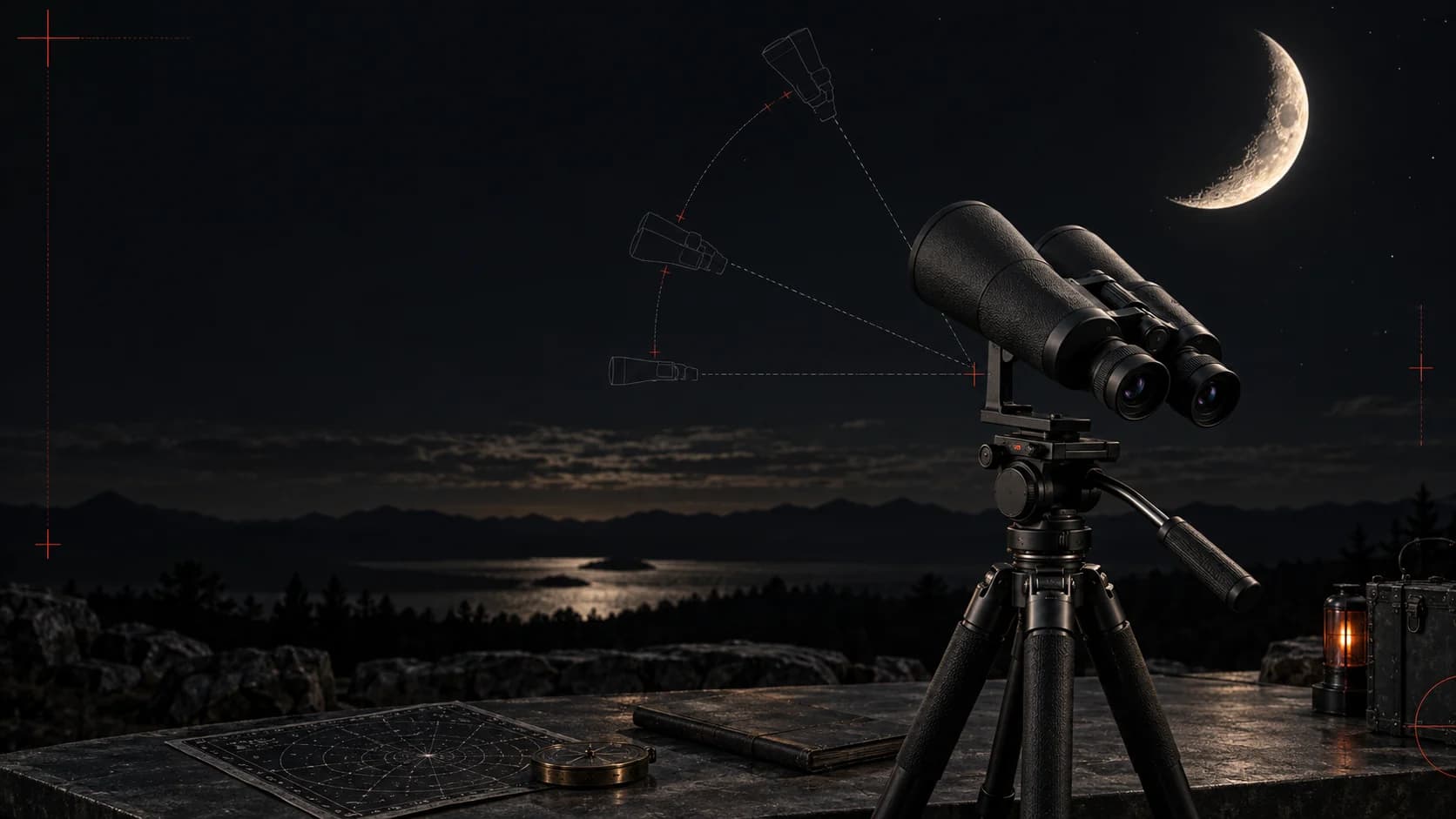
Straight-through binoculars force the observer onto the barrel axis. A conventional tripod can freeze motion while making the body position worse. Treat sixty degrees as a prompt to test posture—not a universal cutoff.
The duplicate-part trap
Open the case before opening a cart.
Celestron currently says the researched SkyMaster 15x70 includes a tripod adapter. Other models may hide a socket behind a cap or use a built-in rail. Inventory beats assumptions.
Read the exact manual
Model-family names do not prove that two production variants share the same mount.
Inspect every pouch
Small adapters and quick-release plates are easy to overlook in foam, caps, and accessory bags.
Measure at your eye spacing
An L adapter can physically fit the thread while colliding with barrels adjusted for your face.
Test the full upward path
A secure connection can still hit the head, handle, or center column before reaching the Moon.
Hard setup boundary
Load low. Lock deliberately.
Attach or remove heavy binoculars with the mount level, the counterweight secured, and one hand controlling the optic. Spread and lock the legs on firm ground. Never improvise extra height with furniture or leave a top-heavy rig unattended.
Short answers before adding hardware.
Do 15x70 binoculars need a tripod for the Moon?
Treat support as part of the 15x70 system. A brief handheld look is possible, but fifteen-power magnification makes movement obvious and a typical full-size 15x70 weighs around 1.36 kg. The useful question is whether the tripod also reaches a comfortable eye position.
Will any binocular tripod adapter fit?
No. Many standard Porro binoculars hide a 1/4-20 socket behind the front hinge cap, but some large models use a built-in rod, underside foot, or proprietary geometry. Thread size, barrel clearance, and tripod-side plate all need to match.
How much tripod capacity do I need?
Start with the lower published rating of the head and legs. This guide uses twice the complete loaded binocular weight as a conservative screening threshold, then requires a real settling-time and height test. That ratio is an editorial filter, not a manufacturer guarantee.
Why is viewing near zenith uncomfortable on a normal tripod?
Straight-through binoculars keep your eyes on the same line as the barrels. As the barrels point up, the eyepieces move toward the observer and often above a comfortable standing position. Taller legs help; a parallelogram can also bring the eyepieces to a reclining or seated observer.
Is a parallelogram mount worth it for 15x70 binoculars?
Only when long, high-angle, shared-height, or reclined viewing is a recurring job. It is a large and expensive solution to observer geometry. For short sessions below about sixty degrees, a suitable tall tripod and fluid head are usually simpler.
Can I use the tripod I already own?
Yes, if you can verify the head and leg ratings, secure the exact connection, reach eye height, tilt upward smoothly, and get acceptably short settling time. Passing those tests is a reason not to replace it.
Inspect the source trail.
Every product figure comes from a current manufacturer page. Availability and specifications can change, so the verification date stays visible and prices stay off the page.
Moon Viewing Tips
NASA ScienceExplains that 10x and 15x binoculars reveal more detail but may require a tripod to keep the view steady.
Open sourceHow to Mount Binoculars on a Tripod
CelestronDocuments the common front-hinge 1/4-20 socket and the adapter-to-photo-tripod connection used by many Celestron binoculars.
Open sourceSkyMaster 15x70
CelestronPublishes a 1,361 g weight and says a tripod adapter is included—an important reason not to order a duplicate blindly.
Open sourceRSR Binocular Tripod Adapter
CelestronPublishes a 1/4-20 tripod interface, 0.5 lb weight, standard-head compatibility, and named Celestron binocular families.
Open sourceHummingbird Fast Action Pan Tilt Head Tripod
CelestronPublishes an 11 lb load, 68.9 in maximum height, 3.86 lb weight, 1/4-20 quick-release plate, and 90-degree platform tilt.
Open source4000 Tall Binocular Tripod/Head
OberwerkPublishes an 11 lb capacity, 78 in maximum height, 24 in minimum height, and 9 lb complete weight for the tall fluid-head system.
Open sourcePM2 Parallelogram Mount
OberwerkPublishes a 2–12 lb payload range, 28 in of target-preserving eyepiece-height travel, 20 lb mount weight, and notes that the matching tripod is not included.
Open source