Somewhere behind the curtain.
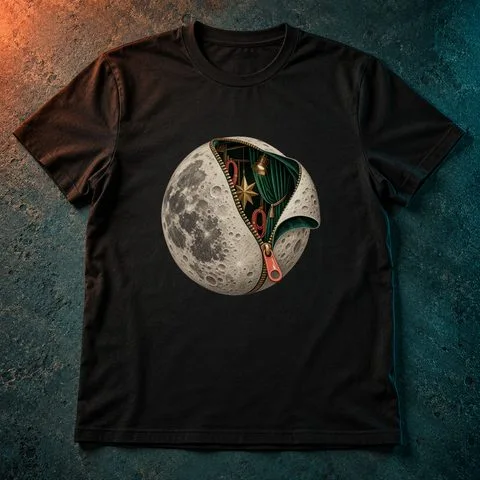
The Moon is so good at being the Moon that we almost stop seeing it. It keeps its appointments, turns up in photographs, hangs above the supermarket car park. Familiarity becomes a kind of camouflage. Then somebody draws a zipper down the middle, and an old object acquires a new problem: what is behind it?
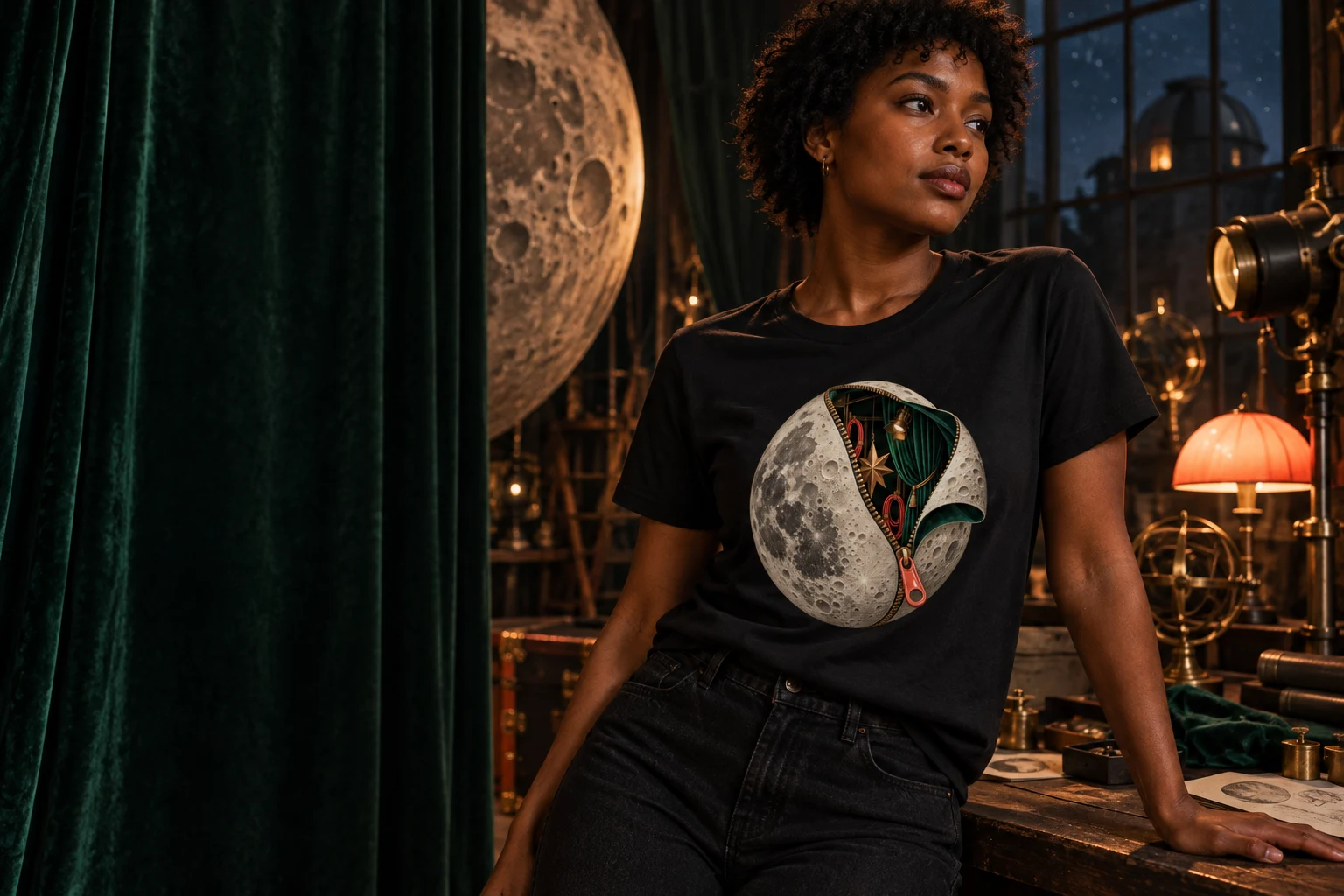
Unzip the Sky starts with that tiny interruption. The outside is cratered and recognizable. The inside belongs to another room entirely: green velvet, a hanging star, cables, a little light. The design doesn't provide a theory of lunar geology. It gives the imagination a handle. Pull here, and the sky becomes a place with working hours.
Make the question an object.
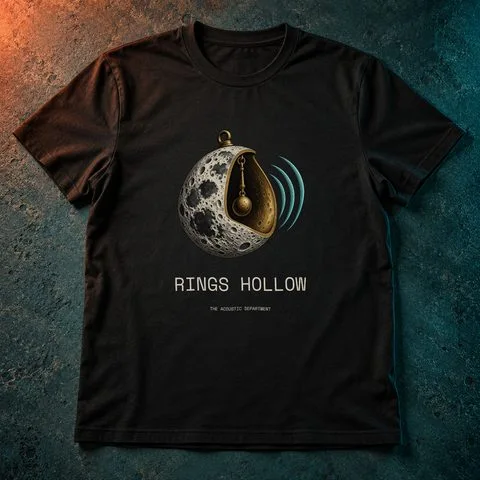
A hollow Moon drawn as a cutaway has a different personality from a hollow Moon announced as a fact. One invites you to look at an impossible interior. The other asks you to agree with a claim. The Conspiracy Department lives comfortably in the first territory. Its switches, doors, and service corridors are original visual fiction, built around questions that already circulate in lunar culture.
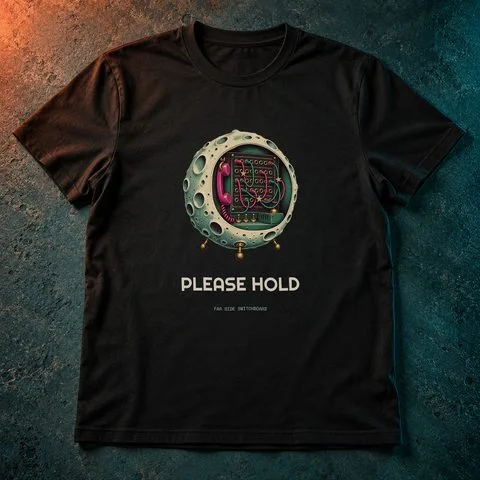
That distinction makes room for more people. You can enjoy Rings Hollow because its structure is strange and beautiful. You can wear Far Side Switchboard because the thought of celestial infrastructure makes you laugh. You can also follow the question into the research archive, where the evidence has a different job from the artwork. Curiosity can move between those rooms without pretending they are the same room.
The ordinary details do the work.
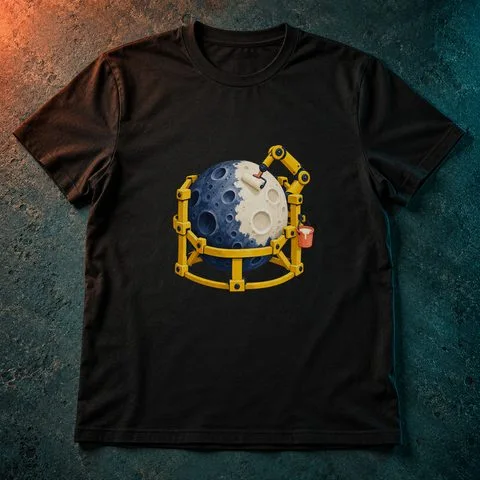
The best part of an impossible machine is often its least impressive component. A cable tie. A worn switch. The label someone should have replaced years ago. Grand mysteries become much more interesting when they need mundane maintenance. If the entire sky were a stage, someone would still have to sweep it.
Our campaign puts the zipper Moon beside velvet curtains and brass equipment. It is an invented backstage, not a found location presented as evidence. The shirt gives the scene its central question; the props let that question spill into a world. The print itself stays the point. It should still work on the bus, in daylight, with no observatory in sight.
Leave the door open.
There is a pleasure in wearing something that rewards a second glance. First, a Moon. Then, a zipper. Then, a room you cannot quite account for. The explanation travels more slowly than the image, and that pause belongs to whoever notices it.
Take the design as a souvenir of an unfinished conversation. Read the hologram investigation if you want to follow the image path. Read the lunar-bell story if the hollow interior is what caught you. Or just keep the little door. Some objects are useful because they stop a familiar thing from becoming invisible.