Source-heavy claim
Did the Moon ring like a bell?
The long seismic signal was real. A hollow or engineered Moon is not required to explain it.
The short answer
Apollo seismometers really did record some impact energy for roughly an hour. The famous phrase described a long, slowly fading instrument trace, not an audible metallic sound.
Lunar seismograms differ sharply from terrestrial ones. Their arrivals build gradually and their codas persist because energy scatters through a heavily fractured outer layer while the material absorbs relatively little of it.
That behavior is strange and scientifically useful. It does not uniquely predict a hollow shell. A claim that strong needs evidence that distinguishes hollow engineering from fractured, low-attenuation rock.
This is an explanatory reconstruction, not a digitized Apollo seismogram.
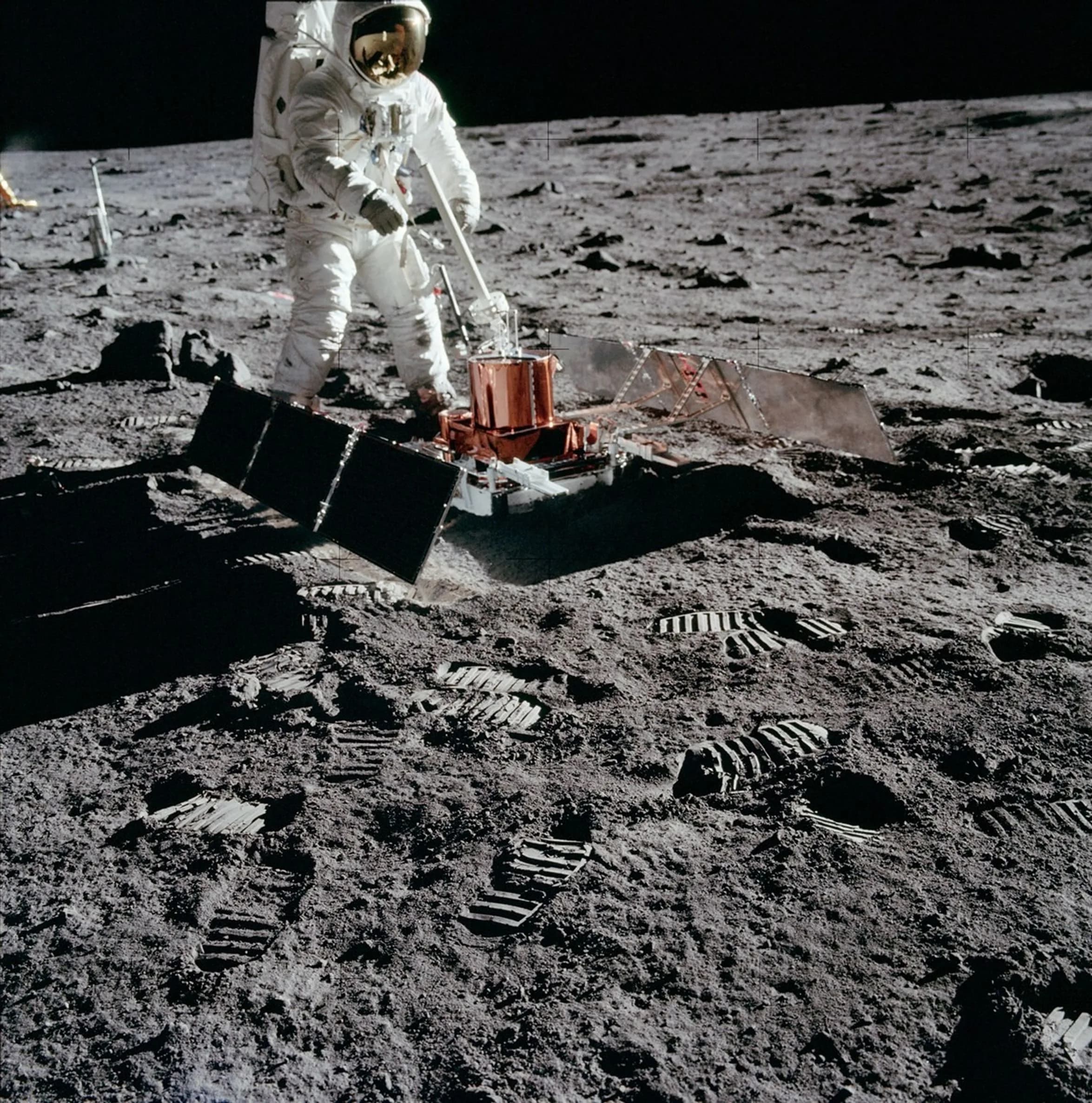
Buzz Aldrin deploys the Apollo 11 passive seismic experiment. NASA.
An analogy became a material claim.
After Apollo 12's ascent stage struck the surface, principal investigator Maurice Ewing compared the continuing reverberation to a church bell. Later retellings often drop the comparison and say the Moon sounded metallic or must be hollow.
Why the signal kept going.
The modern explanation is a combination, not a single dramatic property.
Strong scattering
Impact-fractured rock and regolith redirect seismic energy through many paths, smearing a sharp arrival into a long train.
High Q, or low attenuation
Lunar material can lose less seismic energy per cycle than active, fluid-rich terrestrial crust, so vibrations fade more slowly.
Very low background noise
Without oceans, weather, traffic, and industry, sensitive instruments can follow small late arrivals that would be buried on Earth.
Dryness matters, but is shorthand
The Moon is comparatively dry, which reduces some damping. Scattering and internal friction still matter, and lunar water discoveries do not erase the seismic result.
A hollow Moon would have more consequences.
A large empty shell would affect seismic travel times, total mass, moment of inertia, tidal response, and the gravity field. The Apollo network had limits, but later gravity and laser-ranging measurements add independent constraints.
GRAIL mapped a lumpy, variable crust over denser material and found crustal-thickness estimates that agree with Apollo seismic measurements at landing sites. That is evidence of a layered rocky body, not an undetected Moon-sized void.
Explore the GRAIL data products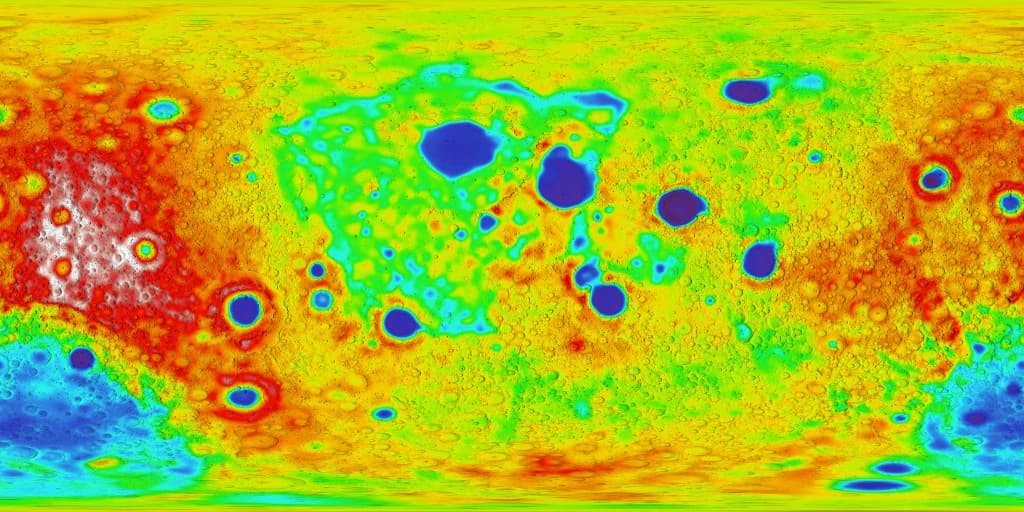
Lunar crustal-thickness map. NASA's Goddard Space Flight Center Scientific Visualization Studio.
What the record supports.
Keep the observation. Test the extra inference separately.
Supported
- Known impacts produced unusually long lunar seismic codas.
- The outer Moon is highly fractured and strongly scatters seismic energy.
- Lunar signals lose energy differently from typical terrestrial signals.
Not established
- That the Moon made an audible metallic sound in the vacuum of space.
- That a long coda uniquely indicates a hollow body.
- That the seismic record requires an engineered shell or artificial origin.
Source trail
Start with the record of the phrase, then move toward the measurements and models that explain it.
Apollo Lunar Surface Experiments Package
NASA-hosted Apollo Lunar Surface JournalPreserves the Apollo 12 impact timeline, the bell analogy, and a contemporary explanation for the unusually long signal.
Open sourceLunar Seismology: The Internal Structure of the Moon
NASA Technical Reports ServerDescribes emergent arrivals, hour-long codas, strong scattering, high Q, and the limits of the four-station Apollo network.
Open sourceSeismic Scattering and Shallow Structure of the Moon
NASA Technical Reports Server recordTests scattering in a high-Q medium and models a fractured scattering layer whose effects diminish with depth.
Open sourceResults from the Apollo 12 Passive Seismic Experiment
U.S. Geological SurveyStates the experiment objective and the role of natural and artificial impacts in inferring lunar structure.
Open sourceApollo 11 Seismic Experiment
NASA ScienceDocuments the first lunar seismometer and the later four-station network that returned data through 1977.
Open sourceGRAIL Primary Mission Gravity Maps
NASA Scientific Visualization StudioExplains how twin spacecraft mapped gravity variations and inferred a nonuniform crust and interior.
Open sourceFollow the story past the quote.
The best version of this rabbit hole is a reading path through Apollo field science, lunar interiors, and the history of the artificial-Moon idea.
We may earn a commission if you buy through this link, at no extra cost to you.
Browse the reading pathBuild an observation kitContinue the investigation
GeometricDo lunar maria encode the shape of Earth's continents?
Visual resemblance is easy to create. A useful version of the claim needs fixed geometry and predictions made in advance.