Transient light claim
Did the Moon just flash?
Some flashes are real meteoroid impacts. A lone glint or color change remains a report until timing, position, signal shape, and independent recordings rule out easier causes.
The short answer
Yes, the Moon can visibly flash. Meteoroids strike at high speed, convert part of their kinetic energy into light, and produce brief events that can be recorded from Earth.
That confirmed mechanism does not validate every historical glow, haze, red patch, or momentary point of light. NASA's 1978 catalog preserves 1,468 descriptions, but a catalog tells us what people reported. Each event still needs its own evidence chain.
The useful question is not whether lunar flashes are possible. It is whether this particular signal survives the checks that distinguish the Moon from the camera, atmosphere, and foreground sky.
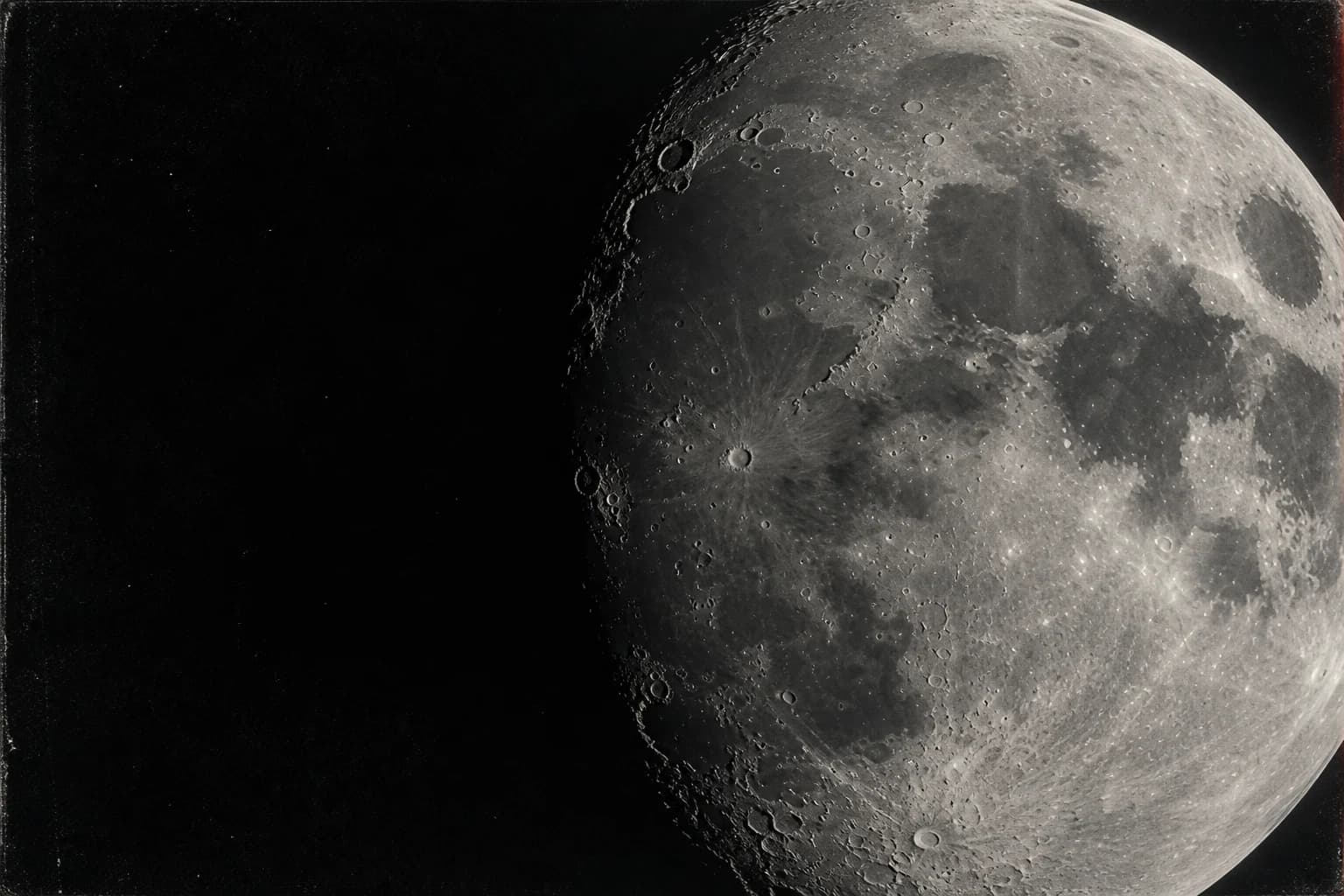 SIM / 23.4 N / 18.1 E
Interactive field triage
What did you actually capture?
Three observations can quickly expose the most common false positives. Choose the closest description of the original record.
A closed evidence loop
From one second of light to a new crater.
The March 17, 2013 event shows what unusually strong verification looks like. The explanation gained a separate physical prediction: a fresh crater should exist at the recorded location.
Flash
A bright event was recorded on the unlit lunar surface for roughly one second.
Fixed location
Timing and position tied the signal to one place on the Moon.
Orbital return
LRO compared images taken before and after the event.
New crater
An 18-meter crater appeared at the predicted site.
Independent orbital imagery tested a consequence of the impact interpretation after the light was gone.
Inspect the before-and-after recordMinimum useful record
Capture what another observer can test.
A dramatic close-up is less useful than an ordinary recording with accurate context left intact.
Keep precise time
Synchronize the capture clock and preserve the exact UTC date and time. A vague time makes independent correlation nearly impossible.
Anchor the position
Save enough of the lunar surface to identify the location. A real surface flash stays fixed against craters while a nearby object can move.
Preserve the sequence
Keep the untouched frames before and after the event. A fast rise and slower fade is more informative than a cropped bright pixel.
Find another observer
A simultaneous recording from a separate location is the strongest practical check against a cosmic ray, sensor noise, and local foreground traffic.
False-positive desk
Three ways the Moon gets blamed.
Start with the failure mode that best matches the recording, then ask what evidence would separate it.
Cosmic ray or sensor noise
A charged particle can produce a bright mark in one frame and one detector. A second simultaneous camera should not repeat it.
Satellite glint or point meteor
A moving foreground object can resemble a flash when only a tiny part of its path is bright or only one frame is inspected.
Seeing, optics, or contrast
Atmospheric shimmer, glare, focus, and changing illumination can make a feature appear to brighten, blur, or change color.
Observe with a purpose
The mystery is open to amateurs.
NASA's monitoring program watches the dark portion of the Moon with two video-equipped telescopes, commonly when lunar illumination is about 10 to 50 percent. The paired view helps reject camera noise.
NASA's current Impact Flash citizen-science project asks for a telescope of at least 4 inches, video capture, and a minimum two-night commitment. Rare events reward patient coverage more than expensive magnification.
Program requirements can change. Verify the current instructions with NASA before buying equipment.
What the record supports.
There is no need to dismiss the observation or overstate the explanation.
Supported
- Meteoroid impacts can produce visible flashes on the Moon.
- Independent video and a fixed lunar position can identify strong candidates.
- Later orbital imagery can sometimes verify a new impact crater.
Not established
- That every historical light or color report came from the lunar surface.
- That an unexplained single-camera signal has an exotic cause.
- That a confirmed impact flash implies lunar activity or technology.
Source trail
Start with the historical reports, then follow the modern detection, reporting, and verification chain.
Lunar Transient Phenomena Catalog
NASA Technical Reports ServerWinifred Cameron's 1978 catalog assembles 1,468 descriptions from the literature. It is a record of reports, not a list of 1,468 confirmed lunar events.
Open sourceAbout Lunar Impact Monitoring
NASA Meteoroid Environment OfficeExplains impact-flash light curves, why continuous video matters, and how cosmic rays, satellites, and point meteors can imitate a lunar event.
Open sourceLunar Impact Monitoring
NASA Meteoroid Environment OfficeDocuments the paired-telescope method used to monitor the unilluminated lunar surface and reject camera-specific noise.
Open sourceLunar Impact Monitoring FAQ
NASA Meteoroid Environment OfficeLists the timing, observer location, lunar position, and independent correlation information needed to evaluate a candidate.
Open sourceBright Explosion on the Moon
NASA ScienceReports the bright, roughly one-second flash recorded on March 17, 2013 and the monitoring context around it.
Open sourceNew Craters on the Moon
NASA ScienceShows how before-and-after Lunar Reconnaissance Orbiter imagery connected the March 2013 flash to a newly formed 18-meter crater.
Open sourceImpact Flash
NASA ScienceInvites observers with a 4-inch or larger telescope and video capability to contribute repeated recordings of the Moon's dark side.
Open sourceBuild for a long watch, not one lucky glance.
Stable tracking and video capture matter more here than extreme magnification. Start with the buyer guide's honest tradeoffs, then match a route to the space you will actually use.
We may earn a commission if you buy through the product link, at no extra cost to you.
Compare all three telescope routes See the compact tracked routeContinue the investigation
ObservableWhat do phases, parallax, and eclipses actually constrain?
Simultaneous observations from separated locations can test distance, direction, and shadow geometry directly.