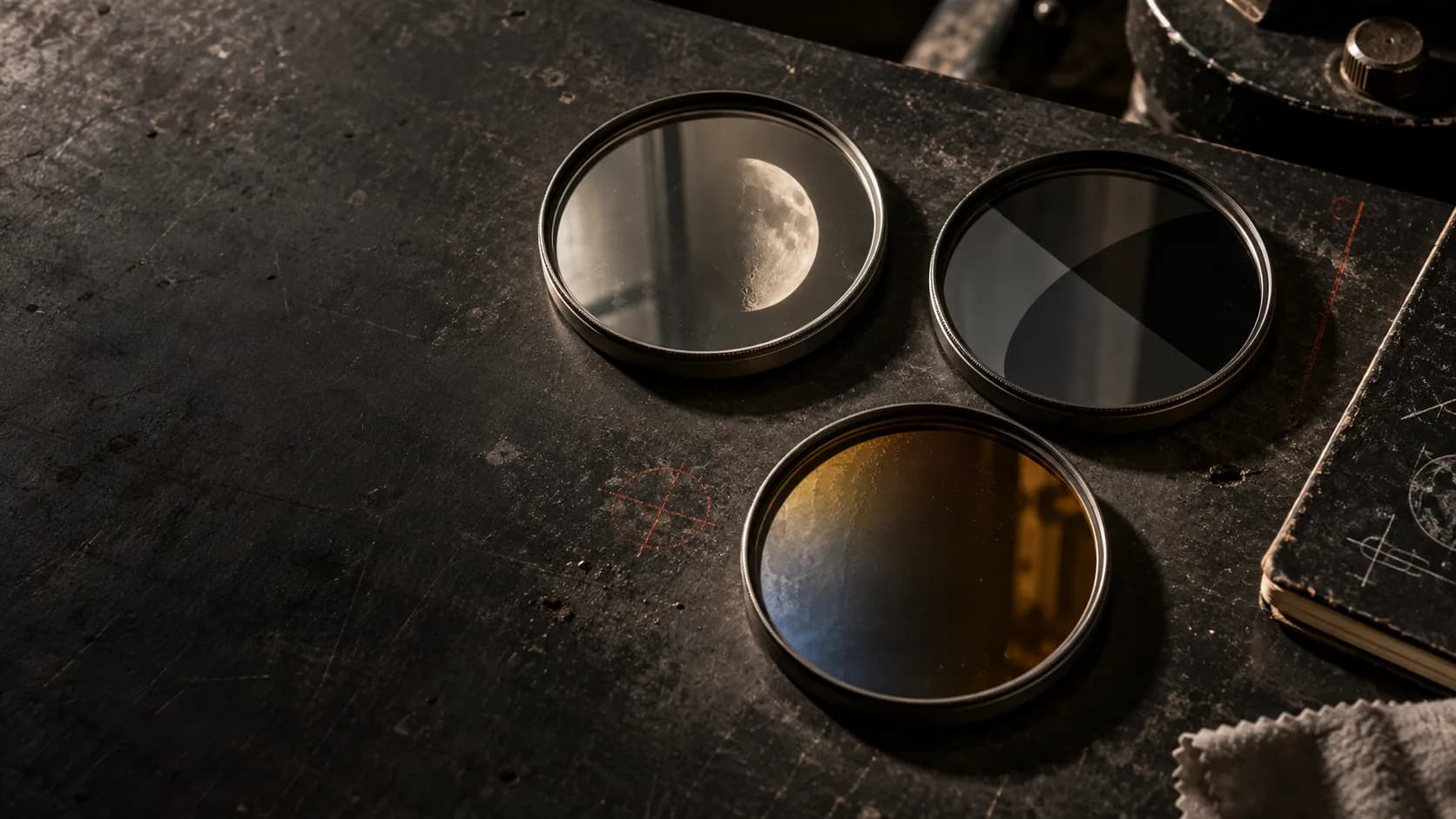
Three-question filter finder
Diagnose before you accessorize.
A filter is useful only when it addresses a repeatable constraint and fits the threaded part of your optical path.
The useful distinction
Dimming is not the same as resolving.
A dimmer image can feel easier to inspect. It does not add spatial detail beyond what aperture, optical quality, focus, and atmospheric steadiness deliver.
Try no filter.
Observe nearer the terminator, begin at lower power, let your eye adapt, or shorten the camera exposure. If the result becomes useful, keep the money.
Reduces visual brightness by a stated amount without intentionally adding a color cast.
Lets the observer tune transmission as the phase, telescope, or magnification changes.
Controls out-of-band light for a compatible camera. It is not a visual brightness filter.
Three defensible purchase routes
Buy the function, not the label.
These are specification-based examples for each route. Confirm thread size and current camera-window details before ordering.
Neutral Density Moon Filter, 1.25 inch
Repeatable brightness reduction for visual observing
- Function
- Fixed neutral density
- Verified spec
- 13% transmission
The simple route. It reduces light without intentionally shifting color and adds no adjustment step at the eyepiece.
The unfiltered Moon is comfortable, you use a 2-inch optical path, or you want one filter to cover very different viewing conditions.
We may earn a commission if you buy through this link.
Check current availabilityVariable Polarizing Filter, 1.25 inch
Tuning brightness across phases and magnifications
- Function
- Adjustable polarizer
- Verified spec
- 1% to 40% transmission
The flexible visual route. Rotation changes transmission, which is useful when one fixed density is too dark one night and too bright another.
A fixed filter already works, you dislike adjusting accessories in the dark, or your optical path is not 1.25 inch and threaded.
We may earn a commission if you buy through this link.
Check current availabilityUV/IR Cut Filter
Compatible planetary cameras without built-in UV/IR cut
- Function
- Imaging bandpass control
- Verified spec
- 1.25-inch and 2-inch versions
A camera-specific route. It targets wavelengths a silicon sensor can record but many visual optical systems do not bring to the same focus.
Your camera already includes an IR-cut window, or exposure and gain changes solve the problem.
We may earn a commission if you buy through this link.
Check current availabilityHard safety boundary
A Moon filter is never a solar filter.
Never look at the Sun through a telescope, camera, or binoculars without a purpose-built solar filter correctly secured over the front of the optics. An eyepiece Moon filter does not provide that protection.
Read NASA safety guidanceShort answers before checkout.
Do I need a Moon filter for a telescope?
Not by default. If the view is comfortable and useful, start without one. A lunar filter controls brightness or camera bandpass; it does not increase the telescope's underlying resolution.
Is a fixed or variable Moon filter better?
A fixed neutral-density filter is simpler when one brightness reduction works consistently. A variable polarizer is more flexible when phase, aperture, and magnification change often.
Should I use a Moon filter for photography?
Start by lowering ISO or gain, shortening exposure, and checking focus. A UV/IR-cut filter is a separate camera-specific tool that only makes sense when the sensor and optical train do not already control those wavelengths.
Can a Moon filter be used to observe the Sun?
No. A Moon filter is not solar-safety equipment. Solar observing requires a purpose-built, correctly installed filter over the front of the telescope, camera lens, or binoculars.
Inspect the source trail.
Product specifications come from manufacturers. Imaging and safety instructions come from NASA. Availability and designs can change.
Neutral Density, Variable Polarizing, and Moon Filter Compared
CelestronDefines the fixed 13% transmission route, the adjustable 1% to 40% route, and the color cast of a basic green Moon filter.
Open sourceNeutral Density Moon Filter, 1.25 inch
CelestronConfirms 13% transmission, neutral color, 1.25-inch eyepiece threading, and stackable threads.
Open sourceVariable Polarizing Filter, 1.25 inch
CelestronConfirms adjustable 1% to 40% transmission, neutral color, and the threaded 1.25-inch format.
Open sourceLunar Photography Guide
NASA ScienceStarts Moon photography with exposure, focus, and existing equipment rather than a filter-first purchase.
Open sourceUV/IR Cut Filters
ZWOExplains why silicon-camera infrared sensitivity can soften an image and lists 1.25-inch and 2-inch options.
Open sourceSolar Viewing Safety
NASA Solar System ExplorationExplains that the Sun requires specialized solar filtration over the front of the optics. A lunar filter is not a solar filter.
Open source