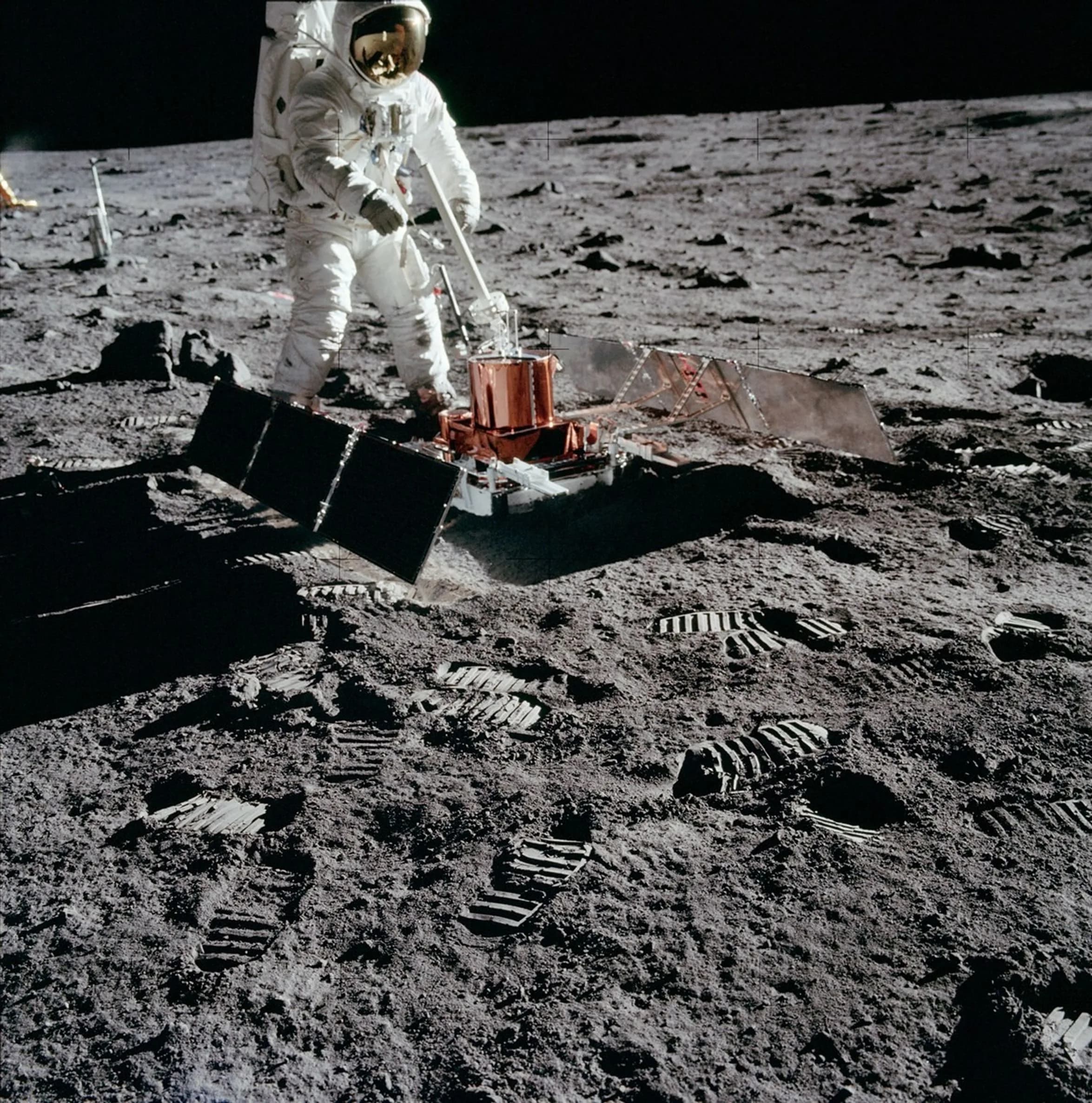
Photographic file / CF-008
Why are there no stars in Apollo Moon photos?
A black sky describes the environment. It does not tell you what the exposure recorded.
The short answer
Apollo surface photographs were usually exposed for astronauts, hardware, and ground in direct sunlight. Stars were present in the sky but too dim to register in those short, daylight-subject exposures.
The black sky is not evidence that the scene was dark. With no substantial lunar atmosphere, there is almost no blue scattered skylight between the Sun and the camera. A sunlit suit can therefore sit beneath a black-looking sky while still requiring a short exposure.
The other famous anomalies also begin as real visual observations: some thin crosshair segments weaken at bright edges, and shadow lines can look non-parallel in a flat reproduction. The next step is not belief or dismissal. It is to model the camera, preserve the whole frame, and recover the three-dimensional scene.
Do not make one anomaly explain another.
- Missing stars
- Exposure and dynamic range
- Fading crosses
- Reseau mark, highlight, and copy chain
- Angled shadows
- Terrain, camera perspective, and one Sun
Interactive exposure workbench
A camera cannot preserve every brightness at once.
Move from a surface-priority exposure toward a star-priority exposure. The thresholds are deliberately broad teaching bands, not a claim to reconstruct one negative.
Choose what the frame must preserve.
Start at a notional sunlit-surface exposure, then add light in one-stop steps. Each stop doubles the captured light.
Analytics receives only the four controlled state labels after consent.
Altered teaching preview / not evidence0 stops / 1x lightBase image: NASA Apollo 11 frame AS11-40-5948. Synthetic stars and exposure wash are instructional overlays.
A dark sky does not guarantee a star exposure.
The model demonstrates the direction of the tradeoff. To evaluate a real photograph, inspect its mission frame, film, camera, scan generation, and neighboring exposures.
Unaltered site copy / AS11-40-5948The crosshair test
Inspect the grid before the crop.
The lunar-surface Hasselblad used a glass reseau plate immediately in front of the film. Its engraved crosses were calibrated measurement references recorded across each exposure—not marks added later for decoration.
If a thin segment seems to pass behind a bright object, compare its contrast at other bright boundaries, open the highest-quality scan, and inspect neighboring frames. A small repost can erase a dark line at a saturated white edge without changing the scene's depth order.
Inspect the camera construction- 01Film negativeReseau plate records thin marks
- 02Scan or printHighlight and contrast decisions enter
- 03Repost or cropCompression removes fine structure
The shadow test
Parallel in space can converge in a photograph.
Railroad tracks are parallel yet converge toward a vanishing point in an image. Sun shadows are also three-dimensional lines projected onto a two-dimensional frame. Camera angle and uneven ground can make their image directions diverge or converge.
Multiple lamps predict a stronger signature: an object should cast multiple sharp shadows. Apparent non-parallelism between different objects, by itself, does not identify a second source.
Conceptual perspective diagram. It does not reconstruct a specific Apollo frame.
Anomaly audit
A screenshot is a lead, not a specimen.
Use this chain before deciding that an odd patch needs an extraordinary mechanism.
Name the frame
Recover the mission, magazine, and frame number. If the claim cannot identify its source, stop treating the crop as primary evidence.
Open the best scan
Compare the highest-resolution archive file with the shared image. Record every crop, rotation, contrast change, and annotation.
Read the neighbors
Inspect frames immediately before and after. Moving camera position, Sun angle, dust, or persistent marks help locate the effect in the scene or imaging chain.
Write a prediction
State what a studio light, composited object, damaged scan, saturation edge, or sloped surface should also produce elsewhere in the frame.
Reproduce the mechanism
Use one bright lamp, uneven ground, thin dark marks, and controlled exposures. A mechanism earns weight when it recreates the claimed signature without special pleading.
What the camera record establishes.
A reproducible photographic effect can answer a defined anomaly. It does not make every Apollo conclusion automatic.
It does establish
- Short exposures for sunlit subjects can record a black sky without recording stars.
- The cross grid came from a calibrated plate in the lunar-surface camera, close to the film plane.
- Terrain and perspective must be reconstructed before image-plane shadow angles identify lighting.
It does not establish
- That every mark, flare, or tonal discontinuity in every mission frame has one cause.
- That a low-resolution reproduction faithfully preserves fine detail from the negative.
- That explaining one photo anomaly independently proves the complete Apollo record.
Source trail
Work from indexed frames and engineering records outward. The most viral copy is rarely the best copy.
Apollo 11 Image Library
NASA Apollo Lunar Surface JournalIndexes the mission frames, camera magazines, high-resolution scans, panorama sequences, and links to the April 1970 lunar-photography report.
Open sourceApollo 11 Hasselblad Cameras
NASA Apollo Lunar Surface JournalDocuments the 60 mm lunar-surface lens and the calibrated glass reseau plate placed immediately in front of the film to record a grid of crosses.
Open sourceWhere are the stars?
NASA ScienceExplains with spacecraft examples that short exposures for bright subjects can leave background stars unrecorded, while longer exposures can reveal stars or star streaks.
Open sourceApollo 12 Lunar Sample Information Catalog
NASA Manned Spacecraft CenterRecords the 70 mm surface cameras, five-by-five reseau array, half-stop aperture detents, and the 1/250-second shutter setting used for almost all Apollo 12 surface frames.
Open sourceThe Dark Side of the Crater
NASA Ames Research CenterDescribes the Moon's unusually stark alternation of direct sunlight and shadow and how regolith texture changes with illumination direction.
Open sourceApollo 11 Photogrammetry
NASA Apollo Lunar Surface JournalUses overlapping surface frames and later LROC imagery to reconstruct camera stations, slopes, craters, boulders, and shadow-changing terrain in three dimensions.
Open sourceDid We Really Land on the Moon? Suggestions for Science Teachers
NASA Technical Reports ServerPreserves the context of the 2001 television claims and points educators toward tests and mission records rather than treating a broadcast crop as a primary source.
Open sourceContinue the investigation
ObservableCan a consumer telescope see the hardware left on the Moon?
No Earth-based consumer telescope resolves meter-scale hardware. Lunar orbiters can, and the scale difference is measurable.