Observable claim
Can we see the Apollo sites?
Consumer telescopes cannot resolve Apollo hardware from Earth. Lunar orbiters can because they are vastly closer.
The short answer
A telescope does not turn magnification into unlimited detail. Its aperture sets a diffraction limit, and Earth's atmosphere usually makes the practical limit worse.
At the Moon's mean distance, even a 300 mm telescope has a theoretical resolution near 720 meters. The Apollo 11 descent stage is roughly 12 feet across. It is not a close call.
This explains why failing to see the hardware through a backyard telescope is expected. It does not, by itself, prove or disprove the landings. The relevant positive evidence comes from many independent lines, including mission records, samples, tracking, retroreflectors, and later orbital imagery.
What can your telescope resolve?
Set the clear aperture printed on the telescope or binocular objective.
Apollo surface hardware is measured in meters. Your result is measured in hundreds or thousands of meters. More magnification cannot recover detail the aperture never resolved.
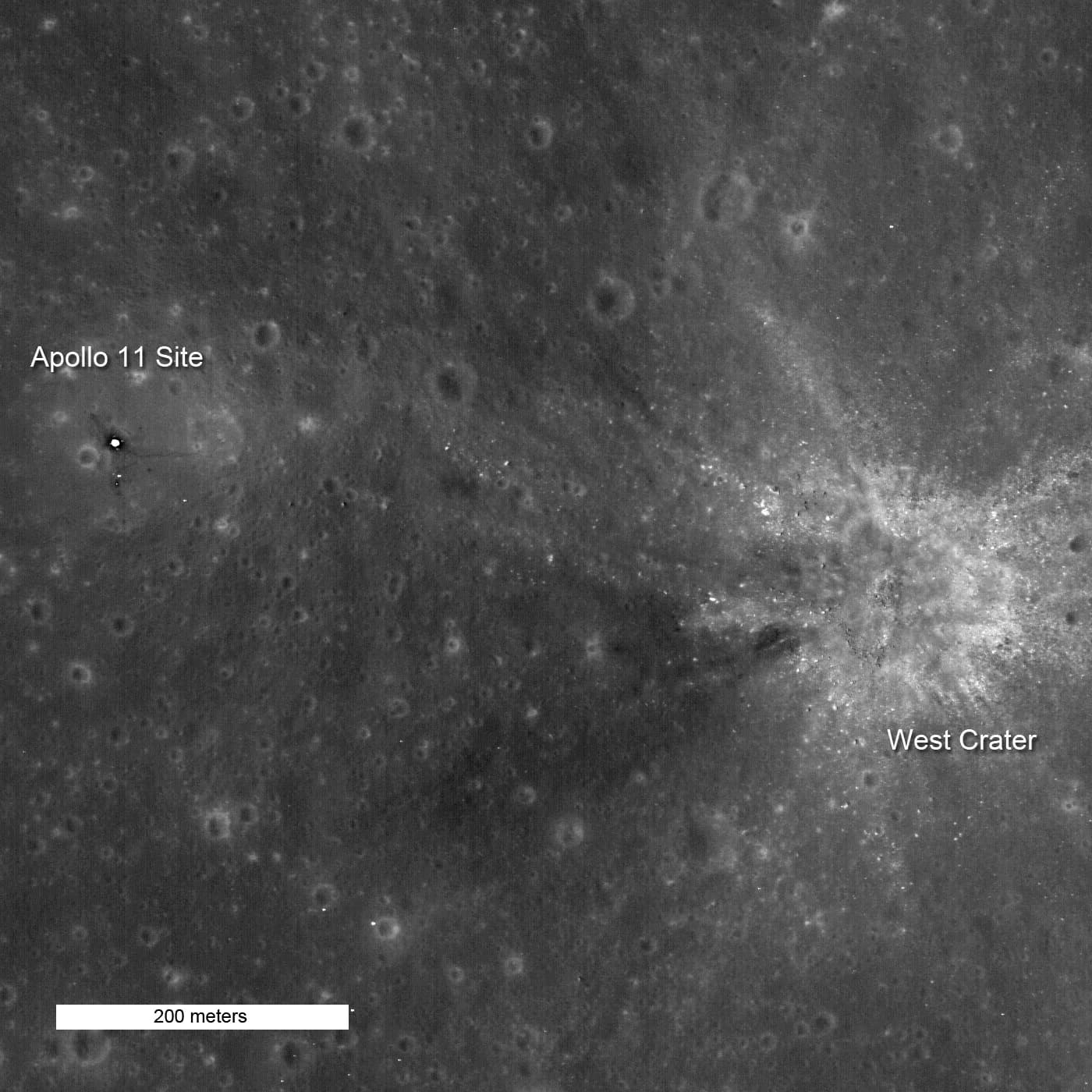
Apollo 11 landing site. NASA/Goddard/Arizona State University. LRO image displayed from NASA SVS.
Change the distance, change the answer.
The Lunar Reconnaissance Orbiter passes tens of kilometers above the surface, not hundreds of thousands. Its narrow-angle camera records features at approximately meter scale.
What this test settles.
A useful test needs an explicit conclusion and an explicit limit.
It does settle
- Why consumer telescopes do not show flags, footprints, or modules.
- Why larger aperture improves detail while empty magnification does not.
- Why a low lunar orbiter can record features that Earth-based optics cannot.
It does not settle
- The authenticity of every Apollo photograph or transmission.
- The provenance of samples, tracking records, or retroreflector data.
- Whether NASA should be treated as the only source in the case.
Source trail
Open the material directly. Each link is labeled by the job it performs in the case.
Apollo 11 Landing Site From Dawn to Dusk
NASA Science and LROCMultiple LRO views under different solar illumination. The descent stage and astronaut tracks are identified.
Open sourceTen Cool Things Seen in the First Year of LRO
NASA Scientific Visualization StudioProvides the displayed Apollo 11 image and identifies the roughly 12-foot descent stage.
Open sourceApollo 11 Landing Site
Lunar Reconnaissance Orbiter CameraLists the source image, coordinates, camera, and one-kilometer image width.
Open sourcePreliminary Considerations of Optical Telescopes for Lunar Surface Use
NASA Technical Reports ServerA historical NASA report that states the Dawes resolution relationship used in the calculator.
Open sourceWant to look anyway?
You cannot see the Apollo hardware, but the Moon remains one of the richest objects for a small telescope. Start with honest expectations and stable optics.
We may earn a commission if you buy through these links, at no extra cost to you.
Compare three telescope picksBrowse the reading pathContinue the investigation
Source-heavyDoes the Moon's density or seismic behavior imply a hollow shell?
Apollo impacts produced long seismic codas, but strong scattering and low attenuation explain the record without requiring a hollow shell.