A flag is a perfect suspect. You can circle it in red, zoom in until the pixels confess and spend an entire evening prosecuting a piece of fabric. A radio trace from an observatory in Cheshire is less cooperative. It doesn't have a face. It won't go viral in a reaction shot. And that is exactly why it belongs in the room.
The serious staging case is broader than a funny shadow: perhaps images and broadcasts could be manufactured while uncrewed hardware supplied other traces. That is a demanding hypothesis. It must explain the records together, not use the word 'robot' as an all-purpose exit whenever a new witness appears.
The argument being tested—not a claim that the theory has been verified.Witness one: somebody else was listening.
Jodrell Bank's own historical account records its tracking of Apollo 11, including Eagle's descent, and shows a dated descent-signal plot. This is an observatory describing its own work, not NASA describing how impressed an observatory ought to have been. That difference is the point of starting here.
It is not a magical radio photograph of Armstrong's boot. Tracking a signal and watching a human walk are different kinds of observation. But a studio-only explanation has to account for a contemporary lunar-directed signal received elsewhere. The plot makes the allegation more specific—and a more specific allegation is much harder to keep conveniently vague.
There is a tempting shortcut on both sides: treat the independent witness as a complete verdict, or dismiss it as another institution in the conspiracy. Neither tells you what the instrument recorded. Start with the trace, the date and the observatory's stated interpretation. Let the witness say only what it can say.
A witness isn't stronger because it is famous. It is stronger when you can name what it actually witnessed.
THE EDITORIAL DESK
Witness two: Japan arrives late to the scene.
In 2008, JAXA reported Kaguya terrain-camera observations around the Apollo 15 landing area. The release describes a possible surface halo associated with the landing and compares reconstructed terrain with the landscape in Apollo photographs. Its stated camera resolution is ten metres. That is a landscape-scale check, not an astronaut-sized photograph.
This matters because independence has two dimensions. Kaguya was a different mission run by a different agency. It was also observing decades later. It cannot supply contemporary testimony, and a possible halo isn't a readable mission serial number. What it can do is confront an image-only argument with terrain that another mission measured.
The staged-landscape hypothesis now owes an account of that agreement. The correct answer is not 'JAXA proves every Apollo frame.' It is that a named, later observation constrains what a persuasive alternative can claim. The case gets more interesting as its escape routes become narrower.
Witness three: the hardware is still inconvenient.
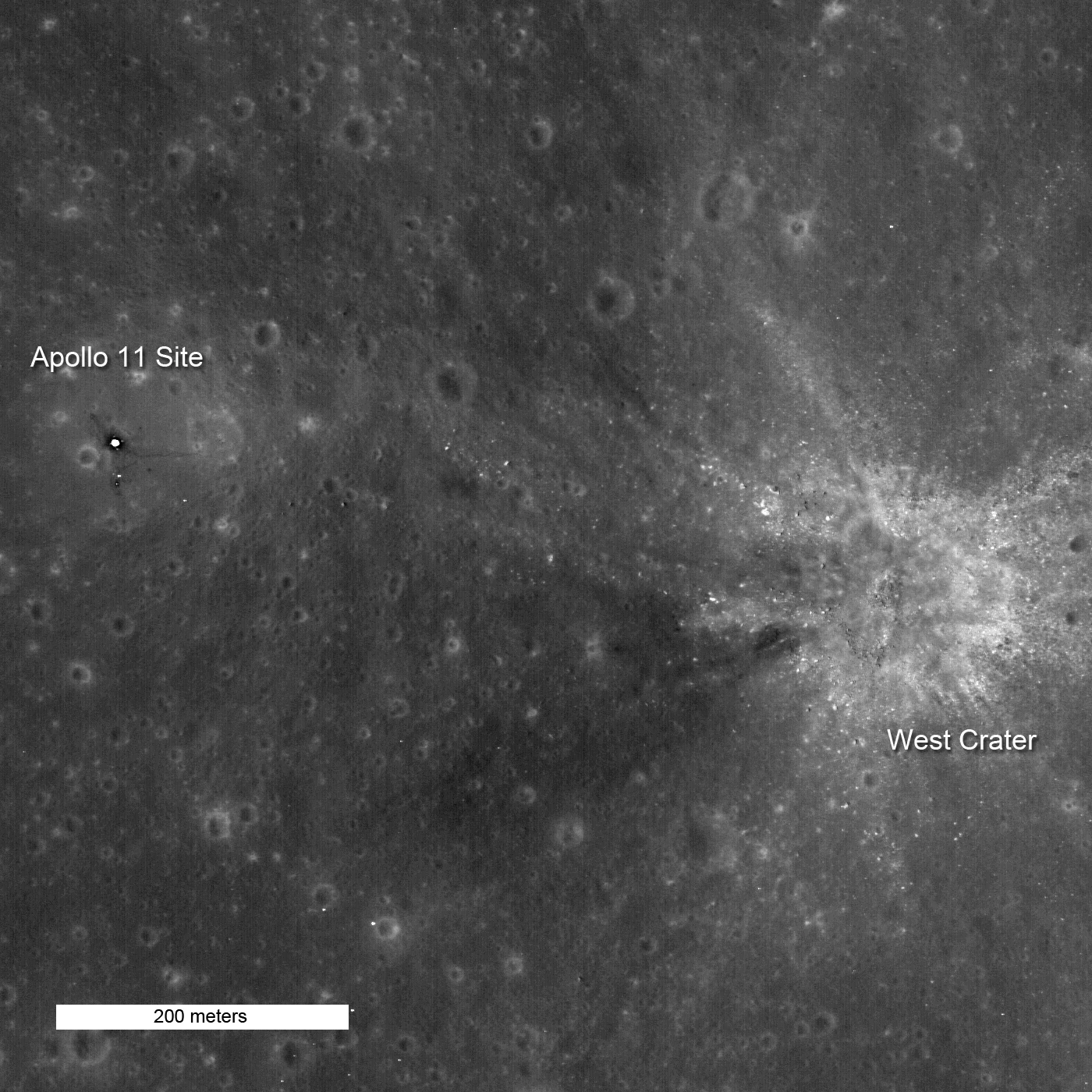
NASA's Lunar Reconnaissance Orbiter shows the Apollo 11 site under changing sunlight. Treat these images honestly: they come from NASA. A person alleging NASA fabricated the mission will not suddenly consider NASA's later camera an independent judge. Yet the images are still specific records with lighting, location and mission provenance, rather than a slogan about authority.
Laser reflectors raise a different problem. The International Laser Ranging Service documents both Apollo arrays and Soviet robotic deployments. That history blocks the easy claim that a returning laser pulse, by itself, proves a person stood beside the reflector. Robots can deliver hardware. Their existence does not establish that an undocumented robotic mission supplied all Apollo evidence.
Keep the useful part of the objection. Ask what landed, where, when and by which documented mechanism. A robot is an engineering proposal, not a blank cheque. If an alternative invokes one, it should produce a mission capable of the particular job—not simply a noun that absorbs every difficult fact.
WHAT IT SAYS / WHAT IT DOESN’T
Contemporary radio tracking
SUPPORTS A received mission signal and its behaviour.
LIMIT Not a direct image of the crew.
Kaguya terrain / possible halo
SUPPORTS A separate agency's later landscape observation.
LIMIT Ten-metre resolution; not individual footprints.
LRO site imagery
SUPPORTS NASA's later observations of site features.
LIMIT Not independent of the accused agency.
Reflector returns
SUPPORTS Hardware that can return ranging signals.
LIMIT Robotic deployment is possible.
The rocks don't come with a reaction thumbnail.
The Lunar and Planetary Institute's sample catalogues put identifiers, photographs and descriptions between you and the broad phrase 'Moon rocks.' The archive is part of the Apollo research ecosystem; provenance should be disclosed, not washed away with the word independent. Still, it lets the dispute attach to named material instead of an imaginary crate of anonymous grey stones.
Our inference is cumulative. No single shelf in this room carries the whole historical conclusion. A competing account has to fit the chronology, the measurements and the material together. Explaining one photograph's appearance does not explain why these other records exist. Equally, finding one real mission record does not excuse a careless explanation of a disputed photograph.
The Why Files' Kubrick chapter is a useful tour of the image objections. Read it as an itinerary, not a substitute for the stops. You can enjoy the possibility of cinema-sized deception while requiring the alternative to do more work than its trailer.
Contemporary tracking, mission archives, samples and later orbital observations jointly support the Apollo account. Their provenance and limits differ. We have not found evidence establishing a staged landing; a robotic alternative must specify how it accounts for the combined record, not merely note that robots exist.
A TEST, NOT A DARE.
Pick one mission and build a dated record: tracking signal, mission transcript, sample identifiers and later terrain imagery. Label which records are NASA-origin and which were independently produced. Record what each establishes before attempting a combined conclusion.
These are suggested exercises, not experiments we claim to have performed.
KEEP A PRIVATE FIELD NOTE ↗Don't ask one photograph to carry the entire Moon. Put the witnesses in the same room. Then see which account can live with all of them.
THE RECEIPTS / LINKS REVIEWED 26 SEP 2026
THE SOURCE SHELF.
Read the record, including its limits. A link to a claim documents what somebody says; it does not endorse it. Videos and social accounts open on their own sites—no embedded trackers or autoplay.
- Primary record / University of Manchester / Jodrell BankThe story of Jodrell Bank ↗
The observatory's account of its own Apollo 11 tracking, including a descent signal plot.
- Primary record / JAXAKaguya observes the Apollo 15 halo ↗
Independent mission; 10-metre terrain-camera resolution. Not a close-up of astronauts or footprints.
- Primary record / JAXAPublic release of Kaguya data archives ↗
The 2009 archive release describes calibrated lunar instrument products, including terrain-camera reflectance and elevation data. This release is not a promise that every historical software link remains supported.
- Primary record / NASA / LROApollo 11 landing site from dawn to dusk ↗
Orbital images at different illumination angles. NASA-produced, not independent of NASA.
- Research / International Laser Ranging ServiceLunar laser ranging ↗
Measurements and reflector history; includes robotic Soviet deployments.
- Research / Lunar and Planetary InstituteLunar sample atlas and catalogues ↗
Sample photographs, descriptions, subdivisions and links to the curator's records.
- Video / The Why FilesCompilation: The Moon is Weird — No, really. The Moon does not make sense ↗
Owner-supplied editorial lead. English auto-caption transcript reviewed 26 September 2026. A narrated claim is not independent evidence; the compilation also retracts some stories.
Open the original source-led case file for the evidence ledger, calculations and observation tools.
OPEN THE FIELD GUIDE ↗