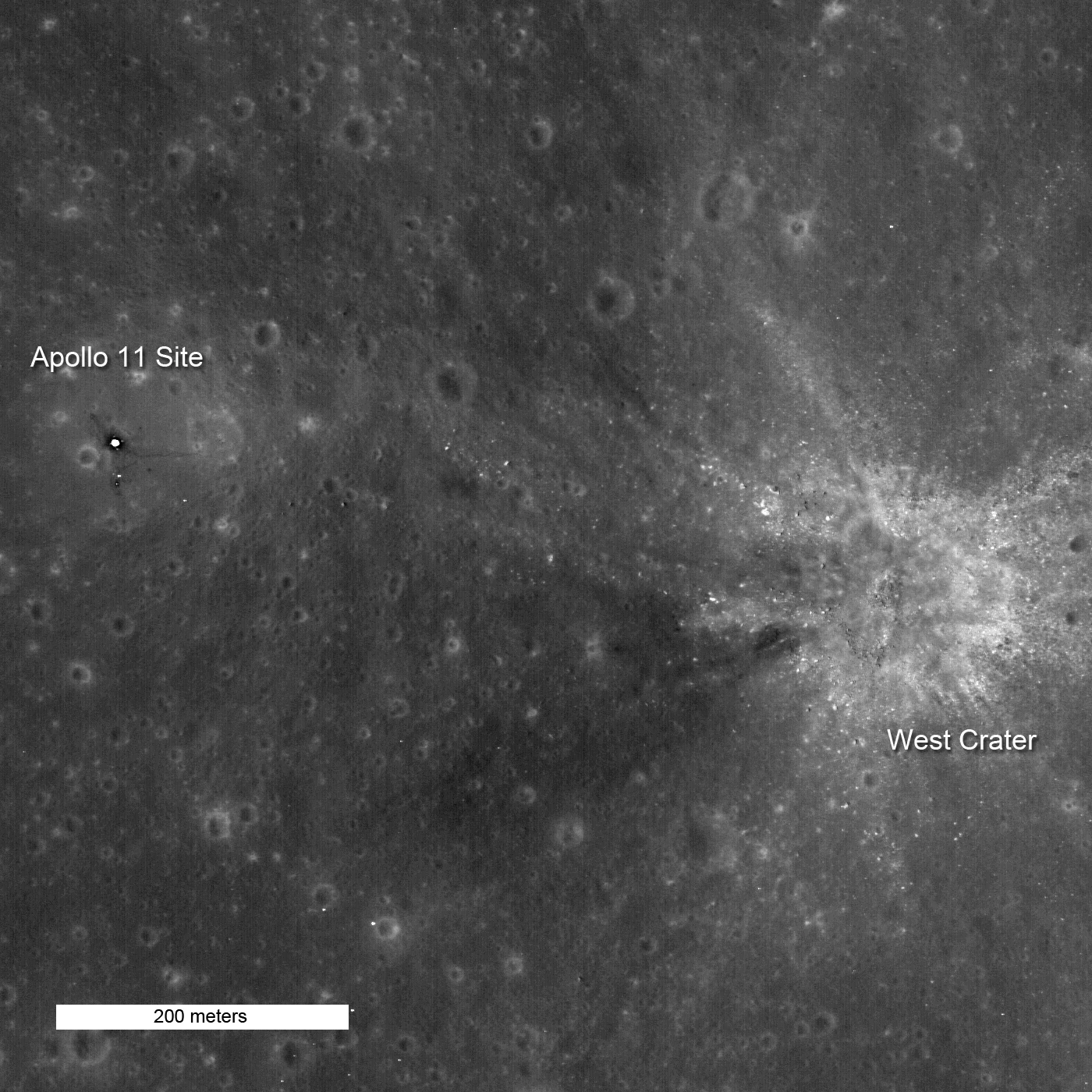
The black sky looks like a production decision. No stars to place incorrectly. No astronomical continuity errors. A perfect backdrop for a location shoot that never left the studio. Then somebody mentions Stanley Kubrick, and the theory gets an auteur. Then somebody mentions a NASA lens—and for once, there really is a receipt.
The staging objection asks whether the recorded sky is compatible with the camera's exposure and the bright foreground. The Kubrick connection adds a separate historical question: which NASA-associated equipment reached his production, and for what documented purpose? A real equipment connection is not a confession.
The argument being tested—not a claim that the theory has been verified.The camera is not obliged to give you the whole universe.
A photograph has to choose what brightness it can record. The Apollo foreground includes sunlit terrain and reflective suits; the stars are comparatively faint. NASA's exposure explainer sets out why a picture made for bright subjects can leave its sky apparently empty. A human expectation of stars is not a camera setting.
The strongest objection would identify an original frame and demonstrate that its documented exposure should have recorded particular stars. That would be a much more interesting problem than a black rectangle in isolation. A rectangle is easy to put on trial; an exposure calculation makes the accusation earn its location.
Don't let this become another ritual in which two camps trade the same sentence. Look at the apparatus. The Apollo Lunar Surface Journal's Hasselblad record gives equipment context for the still images. The television broadcast is another system. An explanation of one does not automatically explain—or incriminate—the other.
Yes, the NASA–Kubrick lens connection is real.
ZEISS's 2022 account of a Planar 0.7/50 mm lens returning to its museum records a batch of ten, with six produced for NASA. It includes executive producer Jan Harlan's recollection of collecting the lens in 1972 and connects it to the candlelight scenes in Barry Lyndon. This is an actual object with a manufacturer and a production history. No mysterious red arrow required.
John Alcott's production interview in American Cinematographer fills in the practical difficulty. Still-camera lenses from the NASA programme were adapted to a Mitchell motion-picture camera by Ed DiGiulio's team. The rear element came extremely close to the film plane, and focus demanded meticulous testing. The connection is concrete, technical and far more interesting than merely saying Kubrick knew people.
It also identifies a documented use: filming dim, candlelit interiors. Moving from that production record to 'therefore Kubrick staged Apollo' requires evidence the lens record does not provide. A shared technology can connect two projects without making one project counterfeit.
- NASA PROGRAMME
A very fast still lens
ZEISS documents a rare batch of Planar 0.7/50 lenses.
- 1972
The production obtains a lens
Jan Harlan's account dates his collection from ZEISS.
- BARRY LYNDON
The camera is modified
Alcott describes the difficult adaptation for candlelit film scenes.
A smoking lens isn't a smoking gun.
The Kubrick idea is compelling because it offers a person capable of manufacturing a convincing image. Capability is not participation. An excellent magician being alive on the day a wallet disappeared isn't enough to arrest the magician. You still need the connection to the act.
The Why Files compilation gives this story a long photographic tour. We are using that chapter to identify questions, not treating a montage as a recovered production log. The claim that a scene could be staged is separate from evidence that the historical scene was staged.
The honest payoff is wonderfully untidy: one popular connection has a real hardware history, yet it does not deliver the conclusion attached to it. Keep that in the article. A story that has to erase inconvenient nuance to stay dramatic was never as good as it looked.
The real connection has a film title. It is Barry Lyndon.
THE EDITORIAL DESK
A starless sky is compatible with an exposure intended for bright sunlit subjects. Production records document Kubrick's use of NASA-programme lenses for Barry Lyndon's candlelit scenes, not for a fabricated Apollo landing. We found no evidence establishing that a real lens connection proves staging.
A TEST, NOT A DARE.
With the same camera, make one exposure for a brightly lit nearby subject and another for a dark sky. Compare the resulting star visibility, retaining both settings. This illustrates exposure limits; it is not a reenactment or an authentication of a particular Apollo negative.
These are suggested exercises, not experiments we claim to have performed.
KEEP A PRIVATE FIELD NOTE ↗The lens is real. The candlelight is real. The missing stars still belong to an exposure question—not a director's credit.
THE RECEIPTS / LINKS REVIEWED 26 SEP 2026
THE SOURCE SHELF.
Read the record, including its limits. A link to a claim documents what somebody says; it does not endorse it. Videos and social accounts open on their own sites—no embedded trackers or autoplay.
- Explainer / NASA Earth MattersWhere are the stars? ↗
Exposure explanation using space photography, not a forensic analysis of every Apollo frame.
- Primary record / Apollo Lunar Surface JournalApollo 11 Hasselblad cameras ↗
Equipment and photographic context for the Apollo 11 still images.
- Primary record / ZEISS / Jan HarlanKubrick's Planar 0.7/50 lens returns to the ZEISS museum ↗
Manufacturer account and recollection by Kubrick's executive producer. Documents a lens connection, not participation in a landing hoax.
- Primary record / American Cinematographer / John AlcottPhotographing Stanley Kubrick's Barry Lyndon ↗
Production interview on adapting NASA-programme still lenses for candlelit film scenes.
- Video / The Why FilesCompilation: The Moon is Weird — No, really. The Moon does not make sense ↗
Owner-supplied editorial lead. English auto-caption transcript reviewed 26 September 2026. A narrated claim is not independent evidence; the compilation also retracts some stories.
Open the original source-led case file for the evidence ledger, calculations and observation tools.
OPEN THE FIELD GUIDE ↗