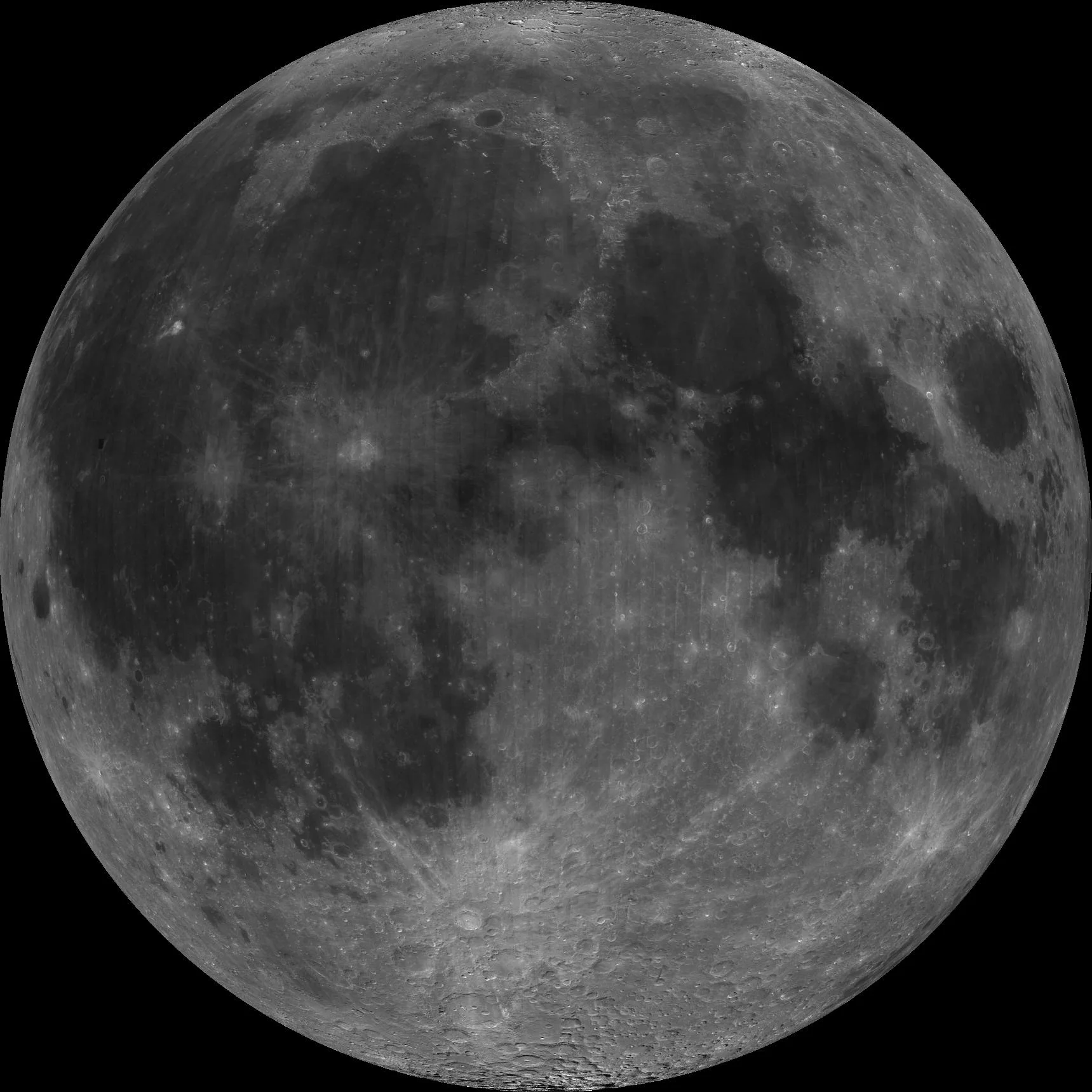
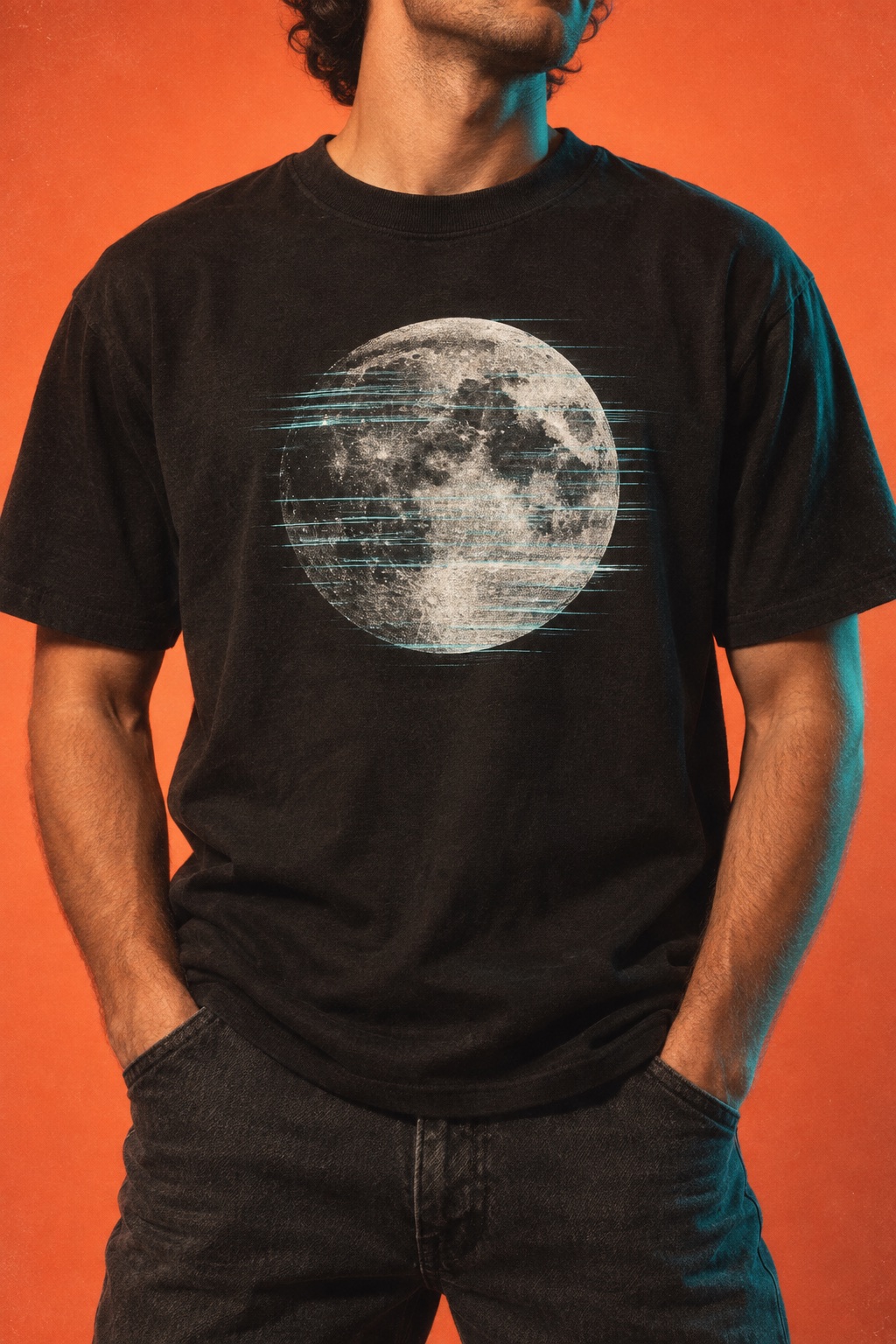
For one frame, the Moon stops being scenery. A band crosses the face, the familiar craters seem to shiver, and the night sky acquires the look of a badly tuned television. You rewind. Then you do the dangerous thing: you watch it with the caption already in your head. HOLOGRAM. Now the disturbance has a job, a motive and, apparently, a technician who should be fired.
The interesting accusation is not that the Moon looks artificial. It is that its image appears to fail. If a discontinuity can be located at the Moon rather than in the imaging chain, the projector idea has a real phenomenon to explain. That 'if' carries almost the entire case.
The argument being tested—not a claim that the theory has been verified.First, which conspiracy are we talking about?
There are two different stories under the same neon sign. In one, the disc itself is a displayed image: the wave is supposedly a glitch in whatever paints the sky. In the other, a physical Moon participates in a system that controls perception. The Why Files compilation explores the latter through David Icke's ideas. That is not the same claim as a telescope filming a projector malfunction.
Merging them makes a fantastic late-night conversation and a terrible case file. A camera artefact cannot establish a mechanism for controlling consciousness. Conversely, a theory about consciousness doesn't tell us what crossed a camera sensor. They need different evidence. We can follow both rabbit holes without pretending the tunnels meet.
This is where the story becomes more interesting than the thumbnail. Is the mystery in the sky, in the equipment, or in the way an image recruits its audience? Each possibility has its own culprit. Only one has to be celestial.
The caption arrives with a culprit. The footage arrives with pixels.
THE EDITORIAL DESK
The original is missing from the witness stand.
Crrow777's publishing site identifies him with the Lunar Wave claim. It is the route back toward a claimant, not a laboratory certificate attached to a repost. We have not obtained and authenticated an original camera file for this feature. The distinction matters: a downloaded social clip can carry cuts, scaling, stabilization, compression and a new clock without advertising any of them.
Imagine trying to investigate a strange telephone call using somebody's ringtone impression. The impression might be excellent. It still isn't the recording. An unusual frame deserves more care than a fast explanation from either camp. 'Obviously a hologram' and 'obviously compression' can be equally lazy if neither person has the file.
What would change the story? Independent recordings with clocks that agree, different sensors, different settings and enough surrounding footage to trace the disturbance. A shared feature on the lunar surface would be far more interesting than two people sharing the same upload.
Follow the signal through the room.
The Moon does not enter your laptop by itself. Light travels through air, optics and a sensor; software turns the result into a file; a platform makes another version. Before accusing the distant object, inspect the witnesses standing much closer to you. This is our investigative ordering, not a diagnosis of the missing original.
NASA's Moon-photography guide is useful precisely because it concerns the act of making an image. Focus, exposure and stability aren't mere housekeeping. They determine what the camera can honestly say. A recognizable crater doesn't make every disturbance around it a property of that crater.
The decisive question is where the effect stays fixed. Does it travel with a particular lunar feature? Does it follow the frame? Does it occur in a second image path? Those aren't instructions for making the clip boring. They're ways of finding out whether the weirdness is bigger than one camera.
WHAT IT SAYS / WHAT IT DOESN’T
A wave in one upload
SUPPORTS Something changed in the displayed image.
LIMIT Doesn't locate the cause at the Moon.
Two synchronized original files
SUPPORTS A way to compare independent imaging chains.
LIMIT Shared atmospheric effects still need examination.
A repeatable lunar-coordinate effect
SUPPORTS A materially stronger anomaly to investigate.
LIMIT Would not, by itself, identify a projector or operator.
Even a counterfeit sky would leave receipts.
The disc is only one part of the accusation. Lunar ranging measures the return time of light; NIST explains the measurement rather than asking you to vote on the Moon's appearance. A physical-image replacement must account for those measurements too. A visual ripple doesn't make the rest of the observational record disappear.
A theory that can always relocate the trick—to the air, to the reflector, to the observer's mind—may remain an engrossing story. It has also stopped offering a way to distinguish itself from every other story. We want the version that risks being wrong. That's the one with somewhere left to go.
So the Moon can keep its unreliable-television energy. We just won't promote a visual resemblance into a discovered machine. The investigation begins where the share button stops: at the original file, the second witness and the things the preferred explanation cannot conveniently ignore.
A visible disturbance is not yet a disturbance of the Moon. We have not authenticated an original lunar-wave recording or found synchronized independent captures that establish a lunar cause. The physical-projector claim remains unsupported; perception-transmitter lore is a separate allegation, not extra evidence for it.
A TEST, NOT A DARE.
Record the Moon and a nearby terrestrial target without changing the camera setup. Preserve the entire recording, frame rate, shutter setting, time and weather. A second observer should record simultaneously. These are controls for the image path—not a promise that one evening can decide the Moon's nature.
These are suggested exercises, not experiments we claim to have performed.
KEEP A PRIVATE FIELD NOTE ↗Keep the strange frame. Keep the frames before and after it, too. A good mystery survives the unglamorous footage; a caption usually doesn't.
THE RECEIPTS / LINKS REVIEWED 26 SEP 2026
THE SOURCE SHELF.
Read the record, including its limits. A link to a claim documents what somebody says; it does not endorse it. Videos and social accounts open on their own sites—no embedded trackers or autoplay.
- Video / The Why FilesCompilation: The Moon is Weird — No, really. The Moon does not make sense ↗
Owner-supplied editorial lead. English auto-caption transcript reviewed 26 September 2026. A narrated claim is not independent evidence; the compilation also retracts some stories.
- Claim context / Crrow777Crrow777 Radio ↗
A proponent's publishing site. Not independent verification or an authenticated original camera file.
- Explainer / NASA ScienceHow to photograph the Moon ↗
Practical observing and camera advice; no purchase is required to begin.
- Explainer / NISTHow do you measure the distance to the Moon? ↗
Time-of-flight and astronomical distance measurement.
- Research / International Laser Ranging ServiceLunar laser ranging ↗
Measurements and reflector history; includes robotic Soviet deployments.
Open the original source-led case file for the evidence ledger, calculations and observation tools.
OPEN THE FIELD GUIDE ↗