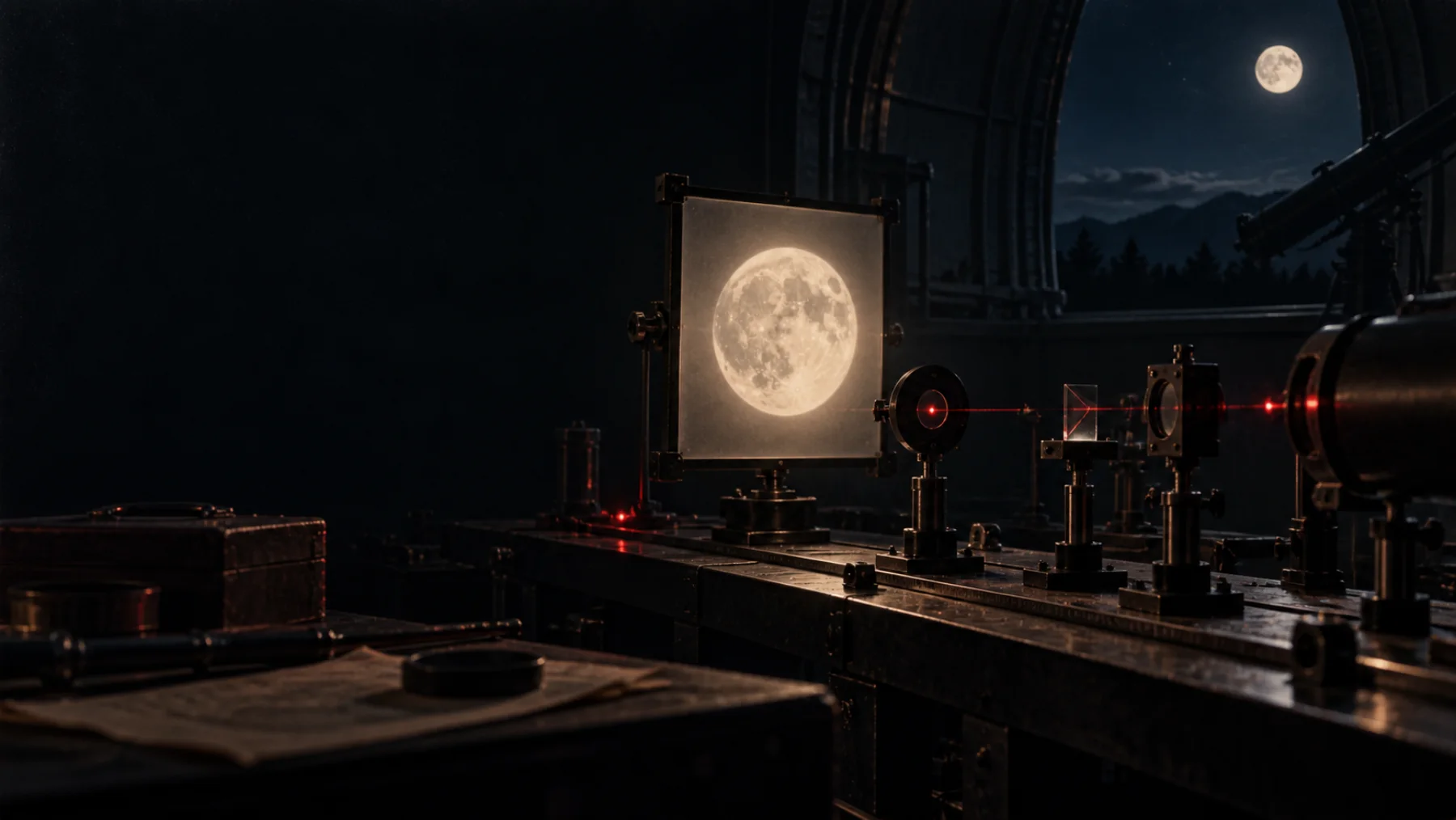
Model under test / CF-006
Could the Moon be a projection?
Give the hypothesis a distance, a screen, and a prediction. Then see what the sky asks it to explain.
The short answer
A simple nearby image does not fit the full observation record. The interesting question is how much physical machinery must be added before “projection” can fit it.
Moon hologram claims often begin with a strange-looking video: a ripple crosses the disk, the edge shimmers, or a dark object seems visible through the bright surface. Those frames deserve optical checks. They do not, by themselves, locate the Moon or identify what produced the image.
Parallax puts the visible target at lunar range. Occultations require it to block background light. Libration changes the geometry of named edge features in a repeatable way. Radar and laser pulses return after the delay expected from the same distance. A model can absorb each result, but every addition becomes another claim that must make its own prediction.
“Hologram” is often a retelling, not the original claim.
A widely shared 2014 “lunar wave” upload asked “Hologram?” in its title, while its description said the creator believed the Moon was physically there but covered. Before testing a claim, preserve what its source actually said.
Inspect the original descriptionInteractive model workbench
Build the strongest version before judging it.
This is not a truth meter. It is an assumption ledger: every switch shows what a projection model must contain to remain compatible with an observation already on the record.
Give the image a location and a mechanism.
“Projection” is not one model. Add only the assumptions you mean, then compare them with four independent observations.
The workbench runs in your browser. Analytics receives only coarse model categories after you press the button.
An open check is not a verdict. It is a request for the model to make one more prediction before the observation is known.
- Selected range
- 80 km
- 1,000 km baseline shift
- 161.8°
Two-observer parallax
Separated observers record a position shift consistent with a target at lunar distance.
Where is the image, and does that location predict the measured shift?
Occultation edge
Stars and planets disappear behind the lunar limb; grazing events trace its hills and valleys.
What material in the model blocks light from a more distant source?
Repeatable libration
Edge features move into and out of view on a predictable monthly geometry.
Does the image remain static, or does the model predict the changing perspective in advance?
Timed radio and laser returns
Independent observatories receive delayed signals from lunar-scale range and mapped surface positions.
What returns the signal, and why does its delay agree with parallax distance?
Delay gives distance. Angle gives size.
Radar uses the round-trip time of a radio signal. Combine that distance with the Moon's angular width and the implied physical diameter follows without using a photograph of the far side.
- One-way distance
- 383,734 km
- Implied diameter
- 3,483 km
Simplified vacuum calculation: distance = light speed × delay ÷ 2. Atmospheric and instrument corrections matter for precision work.
Evidence architecture
One odd frame is weak. Independent methods are hard to fake by accident.
These checks use different instruments, observers, wavelengths, and geometries. Agreement matters more than any single authority.
Visible geometry
Two cameras at separated sites measure the Moon against the same distant star field.
Foreground blocking
A star can disappear sharply at the dark lunar limb and reappear behind a different terrain profile.
Changing viewpoint
Libration reveals repeatable slivers beyond the mean limb instead of random picture warping.
Active ranging
Transmitters send energy toward the Moon and receivers measure its delay, Doppler shift, and surface-dependent echo.
Test the strange footage
Keep the whole frame.
A wave across a magnified Moon can enter through the atmosphere, telescope, mount, sensor readout, codec, editing pipeline, or the target. Cropping to the disk removes the references needed to tell those paths apart.
See a controlled same-camera comparisonReference
Include stars, a terrestrial edge, or a second simultaneous camera when possible.
Raw record
Preserve the original file, exposure, frame rate, codec, time, location, and full uncropped sequence.
Control
Repeat at a different altitude and with a second camera or optical path.
Prediction
Write down where the disturbance should appear outside the lunar disk before reviewing the result.
What the record establishes.
The evidence can reject defined versions of a model. It cannot logically defeat a claim that changes after every result.
It does establish
- A simple nearby, intangible, static image conflicts with multiple independent observations.
- The visible disk, occulting edge, radar surface, and laser targets occupy the same broad lunar-distance system.
- Atmospheric distortion can change recorded appearance without changing the target itself.
It does not establish
- That every unusual Moon video has the same ordinary cause.
- That the word “projection” has one agreed technical definition.
- That compatibility earned by adding assumptions is positive evidence for those assumptions.
Source trail
Start with the claim artifact, then move through optical, geometric, radio, and laser observations that do not depend on one another.
Lunar Wave (Hologram?) & The Moon Lie
Crrow777 / YouTubeA 2014 upload that helped popularize the “lunar wave” discussion. Its own description says the creator thought a physical Moon was present but possibly covered, an important distinction from later retellings.
Open sourcePhotographing the Moon Illusion
NASA ScienceShows a repeatable same-camera comparison and explains how atmospheric refraction can vertically compress the Moon near the horizon.
Open sourceMoon Essentials: Parallax
NASA Scientific Visualization StudioCompares simultaneous views from separated cities and makes the Moon's shift against the background stars visible.
Open sourceWhat’s Up: March 2017
NASA Jet Propulsion LaboratoryDocuments the Moon blocking Aldebaran and explains how a grazing event can repeatedly hide and reveal the star behind lunar hills and valleys.
Open sourceMoon Wobble
NASA Scientific Visualization StudioVisualizes the repeatable monthly change in viewing angle called libration, through which about 59 percent of the lunar surface becomes visible over time.
Open sourcePlanetary Radar
NASA Jet Propulsion LaboratoryDefines radar round-trip delay as twice the target range divided by light speed and gives the Moon's echo delay as about two and a half seconds.
Open sourceMoon’s Rugged South Polar Region Composite
NASA / JPLPresents Goldstone radar reflectance and topographic data for a 500 by 400 kilometer lunar south-polar region.
Open sourceLunar Laser Ranging
International Laser Ranging Service / NASA GSFCDescribes the international observatory network, reflector locations, archived range data, and the scientific measurements derived from timed laser returns.
Open sourceContinue the investigation
ObservableWhy does the horizon Moon look enormous?
The perceived enlargement is real, but same-scale photographs usually preserve the Moon's horizontal diameter. The full perceptual mechanism remains debated.