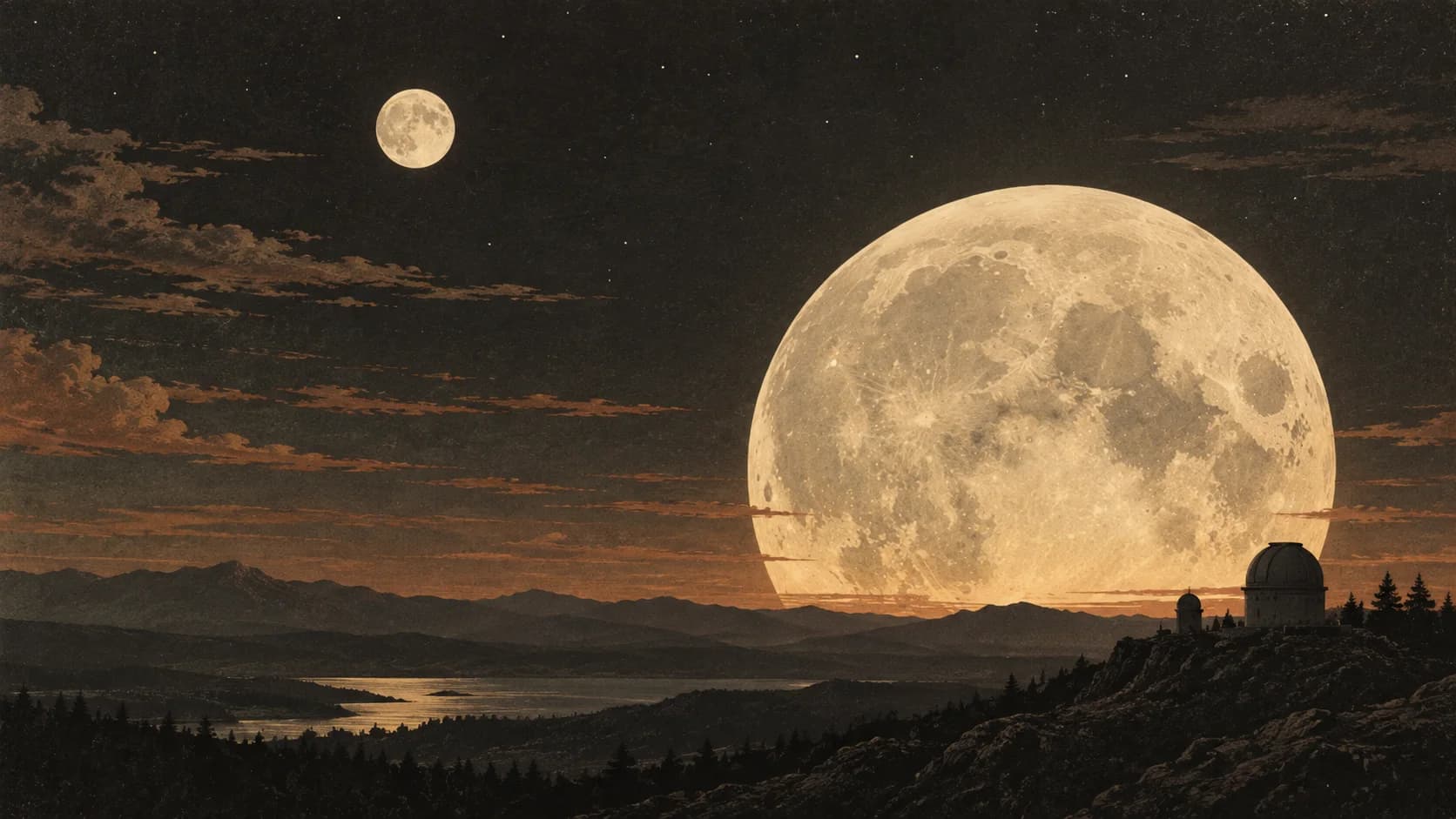
Perception file / CF-007
Why does the horizon Moon look enormous?
The experience is real. The apparent enlargement is testable. Keep both facts in view.
The short answer
A low Moon usually does not occupy a wider angle than the same Moon high in the sky, even when it looks dramatically larger.
A camera held at the same zoom and image scale turns that claim into a measurement. The horizontal diameter should remain nearly unchanged. Near the horizon, the atmosphere can flatten the Moon vertically and redden it, but it does not provide the enlargement your visual system reports.
Calling the effect an illusion does not explain it away. Context, perceived distance, foreground scale, eye position, and other cues can contribute. Researchers still debate how those pieces combine in natural viewing.
The size result is clearer than the mechanism.
Equal-size photographs can show that the lunar image did not expand. They cannot, by themselves, tell us why the brain produced such a convincing difference.
Read NASA's open explanationInteractive field experiment
Move from “it looks bigger” to a controlled comparison.
First test how context steers your judgment. Then enter measurements from your own photographs. Neither step requires buying anything.
Which Moon looks larger?
Answer on first impression. The reveal comes after your choice.
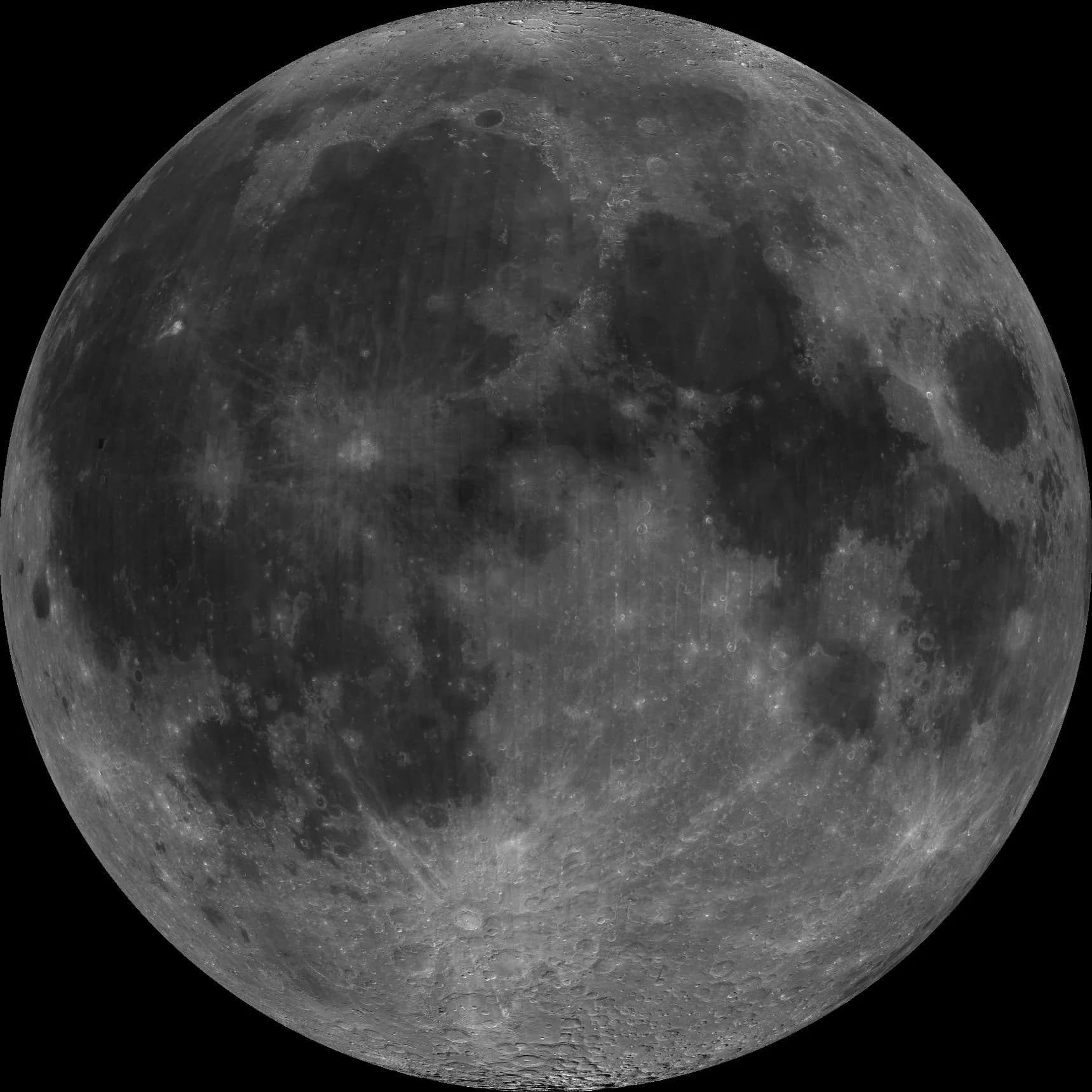
The two scenes are ready. Choose the Moon that appears larger to expose the fixed-size comparison.
Let pixels replace memory.
Measure the widest horizontal diameter in each original, uncropped frame.
Enter both horizontal diameters and confirm the capture scale to calculate a comparison.
Same-night protocol
A fair comparison keeps the scale fixed.
Use the camera you already own. The controls matter more than the equipment.
Capture low
Photograph the Moon near the horizon. Record the time, lens or phone, zoom, image dimensions, and exposure. Keep the original file.
Lock the chain
Disable automatic lens switching and avoid digital resizing. Mark the focal length or zoom so the later frame uses the same image scale.
Capture high
Photograph the Moon later with the same camera orientation and scale. Use a timer or stable support, and avoid a blown-out edge.
Measure wide
In each uncropped original, count the widest horizontal diameter. A low Moon can be vertically compressed by atmospheric refraction.
Repeat
Run another pair on a different night. Repetition reveals your normal focusing, exposure, and edge-selection error.
Zero-dollar controls
Three ways to interrupt the effect.
These checks are rough, immediate, and more useful than comparing the present Moon with a memory from hours earlier.
Paper tube
View the low Moon through a rolled sheet of paper. Removing most horizon context often weakens the impression.
Fingernail gauge
At a fixed arm length, compare the Moon with the same fingernail width when it is low and high.
Upside-down view
Bend safely and view the horizon Moon upside down between your legs; the changed scene can reduce familiar size cues.
What the experiment establishes.
A controlled image answers a narrower—and stronger—question than a general theory of perception.
It can establish
- Whether the Moon occupied nearly the same horizontal pixel diameter in two same-scale frames.
- Whether a remembered size change survives a recorded comparison.
- Whether an unusually large difference repeats after capture controls are tightened.
It does not establish
- One complete psychological mechanism for every observer and landscape.
- That the Moon's angular size never changes as its real distance from Earth changes.
- That an uncontrolled phone image proves either atmospheric magnification or a changing Moon.
Source trail
Start with the official measurement protocol, then inspect primary research on the perceptual explanations.
The Moon Illusion: Why Does the Moon Look So Big Sometimes?
NASA ScienceSeparates perceived enlargement from atmospheric effects, demonstrates the paper-tube and fingernail checks, and notes that no single explanation fully settles the illusion.
Open sourcePhotographing the Moon Illusion
NASA ScienceDescribes a same-camera diameter comparison and explains why the low Moon's horizontal diameter is the useful measure when refraction squashes it vertically.
Open sourceHow to Photograph the Moon
NASA ScienceCovers foreground composition, stable support, self-timers, zoom, and exposure choices for recording the Moon without turning it into a featureless bright spot.
Open sourceSupermoons
NASA ScienceShows that apparent size can genuinely vary between different full Moons as lunar distance changes. A same-night illusion test avoids confusing that slower variation with horizon context.
Open sourceExplaining the Moon illusion
Proceedings of the National Academy of SciencesKaufman and Kaufman's experiments support a perceived-distance account while illustrating why the visual phenomenon needs controlled psychophysical testing.
Open sourceThe natural moon illusion: a multifactor angular account
PerceptionReports that the amount of perceived enlargement varies with conditions including horizon detail and argues for multiple contributing cues rather than one universal trigger.
Open sourceContinue the investigation
Source-heavyDo missing stars, crosshairs, and angled shadows show that Apollo photographs were staged?
Short exposures explain missing stars; calibrated reseau marks and shadow geometry require original-frame and 3D checks. Each effect is reproducible without a studio.