A manufactured Moon is an irresistible piece of design criticism. Who chose the finish? Why those craters? Where is the access panel? Once you picture a shell, every feature begins to look like a decision. But the imagined blueprint has competition: instruments that weren't told to look for corridors.
The artificial-interior proposal becomes testable when it specifies mass distribution, shell thickness and material. Strange surface features can motivate that proposal, but they cannot choose those values for it. A blueprint must survive gravity and seismic observations simultaneously.
The argument being tested—not a claim that the theory has been verified.Floor plan A: a very large object with very small instructions.
The hollow-Moon story often arrives as an accumulation of oddities. Long seismic reverberation. Craters that look suspiciously tidy. An eclipse that appears commissioned. Each item can be worth exploring without adding up to an engineering specification. A mystery collection is not yet a model of a machine.
Imagine commissioning the object from that description. The manufacturer would still need its dimensions, its materials and where the mass goes. 'Artificial' isn't a material. 'Hollow' doesn't say how hollow. And 'it looks designed' does not tell a wave travelling through it what to do.
That is the opening we want to give this theory: not a quick dismissal, but a demand for a real proposal. If someone has built the Moon, its physical construction ought to have consequences outside the examples that made the theory attractive. A theory with consequences has a chance of surprising us. A theory with only adjectives does not.
Artificial is not a material. Hollow is not a dimension.
THE EDITORIAL DESK
Floor plan B: let the spacecraft feel the mass.
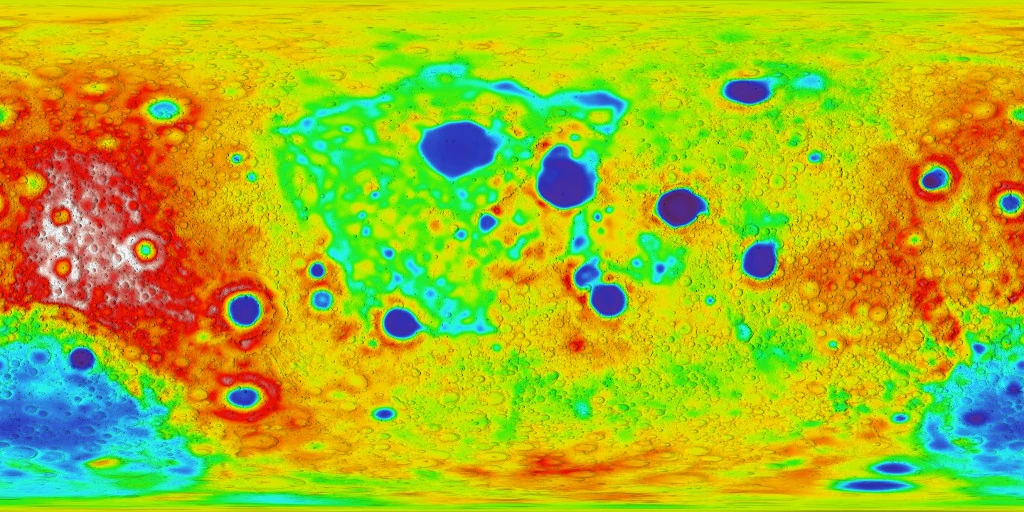
GRAIL flew two spacecraft whose changing separation recorded variations in lunar gravity. NASA's supercomputing account describes comparing those gravity maps with measured topography to investigate subsurface structure. It reports a crust more porous and fractured than previously thought. That is an unexpectedly battered interior, not a clean science-fiction cavity.
The inference is not infallible and the map isn't an X-ray photograph. It depends on how researchers relate shape, density and gravity. Those dependencies are reasons to read the model carefully, not reasons to discard measurement altogether. A specified engineered shell would have to produce a gravity field too.
This makes a better contest than 'natural looks messy, artificial looks regular.' Two explanations can be compared against the same instrument. We can ask which distribution of mass accounts for the observed variations rather than which story makes the best wallpaper.
WHAT IT SAYS / WHAT IT DOESN’T
Gravity maps
SUPPORTS Constraints on where mass is distributed.
LIMIT Interior interpretation depends on modelling and topography.
Seismic signals
SUPPORTS Constraints on wave travel through the body.
LIMIT Not a literal picture of cavities.
An artificial-shell sketch
SUPPORTS A hypothesis with measurable consequences, if specified.
LIMIT A drawing alone establishes no builder or mechanism.
The theory doesn't get to change architects halfway through.
Kiefer's moonquake discussion describes a core, mantle and crust inferred from complementary evidence. It also leaves questions about deep moonquakes open. Uncertainty is real. It is not a reserved parking space for whichever elaborate explanation arrives next.
An engineered hypothesis can still challenge this account. But if every conflicting observation means its builders added another secret material, it is being protected from comparison rather than improved by it. The extraordinary technology is doing all the argumentative work while remaining unspecified.
Our editorial position is not that natural formation must be aesthetically satisfying. Nature owes us no satisfying origin montage. It is that the manufactured alternative needs a floor plan detailed enough to collide with reality. That collision would be far more exciting than another montage of circles and question marks.
The retrieved seismic and gravity records support investigating a layered, fractured lunar body. They do not identify an artificial hollow shell. An engineered model remains a speculative interpretation until it supplies and tests a specific interior against the same measurements.
A TEST, NOT A DARE.
Write down the proposed shell's material, thickness and central cavity before consulting a gravity map. Label which choices come from measurements and which are assumptions. Compare the complete proposal with a layered-rock model; do not silently redraw the shell after each inconvenient result.
These are suggested exercises, not experiments we claim to have performed.
KEEP A PRIVATE FIELD NOTE ↗Keep the access-panel joke. Draw the mass distribution before you order the key.
THE RECEIPTS / LINKS REVIEWED 26 SEP 2026
THE SOURCE SHELF.
Read the record, including its limits. A link to a claim documents what somebody says; it does not endorse it. Videos and social accounts open on their own sites—no embedded trackers or autoplay.
- Research / USGS / G. LathamResults from the Apollo 12 passive seismic experiment ↗
1971 scientific report; explains the experiment's purpose and limits.
- Research / NASA Advanced SupercomputingGRAIL gravity maps: Moon's crust and interior ↗
Gravity/topography comparison constrains crustal density and porosity. Density inference is model-dependent, not a photograph of the interior.
- Explainer / NASA Gravity AssistThe Moon Quakes! With Walter Kiefer ↗
Scientist interview and transcript discussing seismic structure and gravity measurements.
Open the original source-led case file for the evidence ledger, calculations and observation tools.
OPEN THE FIELD GUIDE ↗