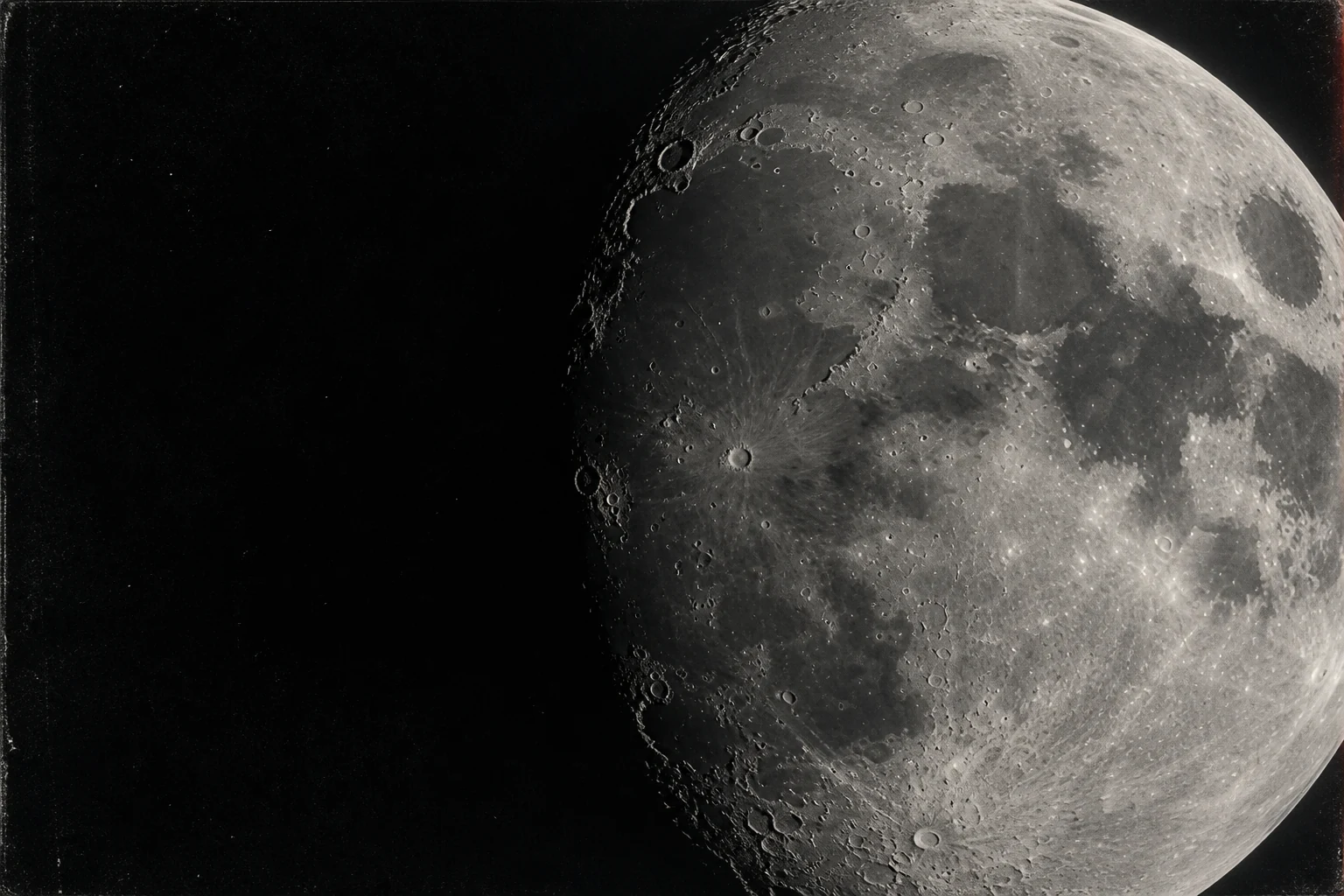

Look at enough lunar craters and the Moon starts resembling something manufactured: a punched sheet, a mould, a piece of hardware with repetitive marks. Why so round? Why not a mess of skid marks? The design suspicion starts with a pattern your eye is extremely good at collecting.
The workmanship argument sees repeated circular structures as evidence of a repeated process—perhaps a tool rather than an impact. The important move is to identify a signature specific to that proposed process across rims, interiors and surroundings, not just collect neat outlines.
The argument being tested—not a claim that the theory has been verified.The suspiciously tidy damage report.
Give the engineering interpretation a fair sample, not a greatest-hits reel. Pick the locations before examining their shapes. Include broken rims, overlapping features, clean circles and awkward ones. If workmanship is really there, it shouldn't depend on selecting only the pieces that flatter the thesis.
Now look past the outline. What happens at the rim, inside the depression and around it? A manufacturing model should explain the whole structure, not just the bit that looks like a compass drawing. Before-and-after images of new craters add another challenge: the theory has to account for a newly changed surface.
An unexpected common signature could be an excellent lead. A circle is less exclusive. Make the proposed machine leave something only that machine predicts, and the case becomes more than a very stylish stencil audit.
Not a stencil audit.
NASA's crater guide describes lunar impact landforms. The useful question is not whether a crater looks pleasingly circular, but whether its structure fits an impact interpretation across more than a cropped outline.
Our proposed comparison includes a variety of sizes and preservation states. Selecting only the cleanest circles would build the desired answer into the sample.
The before-and-after advantage.
LRO's new-crater material shows surface changes between observations. That is a stronger kind of record than interpreting an ancient crater's shape alone.
A claim of manufacture needs an alternative account of the new depression and surrounding change. Geometric neatness by itself does not supply an operator, tool or construction history.
A crater's plan shape is only one part of its geology. Look at rims, ejecta, overlaps and scale.
A TEST, NOT A DARE.
Pick a crater sample before examining their shapes. Record diameter, rim, central features and overlaps; count awkward examples as carefully as attractive circles.
These are suggested exercises, not experiments we claim to have performed.
KEEP A PRIVATE FIELD NOTE ↗Keep looking for the tool marks. Count the craters that refuse to look designed, too.
THE RECEIPTS / LINKS REVIEWED 25 SEP 2026
THE SOURCE SHELF.
Read the record, including its limits. A link to a claim documents what somebody says; it does not endorse it. Videos and social accounts open on their own sites—no embedded trackers or autoplay.
- Explainer / NASA ScienceMoon craters ↗
Impact geology and named lunar landforms.
- Primary record / NASA / LRONew craters on the Moon ↗
Before-and-after orbital observations of new impacts.