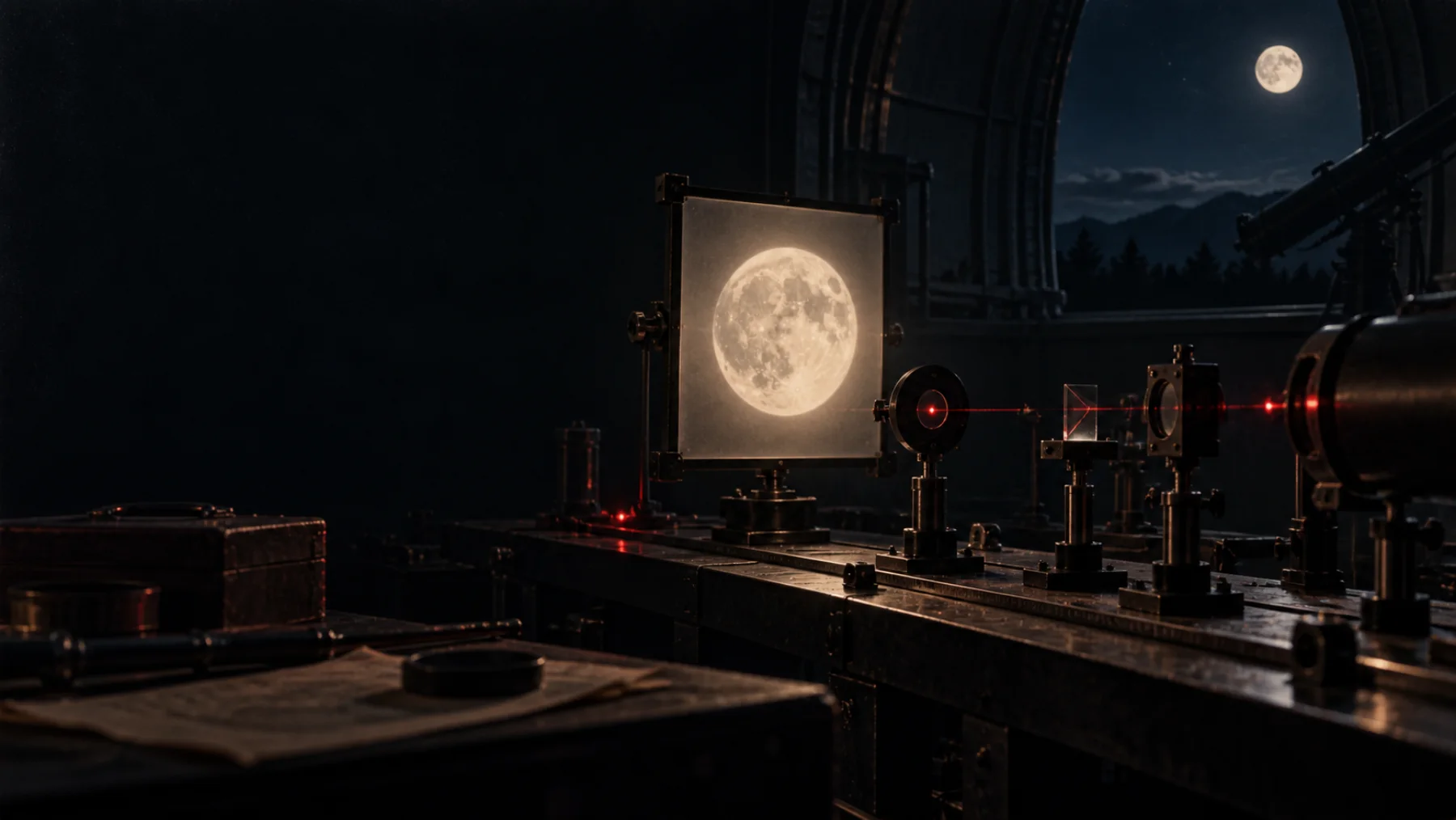
The local-Moon idea starts by pulling the sky indoors. What looks like a distant world might instead be a light within our own neighbourhood. Distance becomes the alleged illusion. Suddenly every cloud, apparent change in size and personal-looking moonrise feels like a possible leak in the set.
The local-Moon theory reinterprets apparent size, position and personal-looking motion as signs of a nearby object rather than a distant world. Its strongest move is to assign that object a distance and predict the simultaneous views of two separated observers.
The argument being tested—not a claim that the theory has been verified.Bring the sky down to street level.
Give the theory a number. Not 'nearer than they say,' but a proposed distance or altitude and a description of the object. That lets two observers ask where it should appear at the same moment. The nearer the model places it, the more important that shared-view test becomes.
Parallax is the change in apparent direction with viewpoint. The NASA visualization explains the geometry; NIST describes distance measurement. Neither should be mistaken for a field experiment we personally conducted. They provide a framework for the experiment the local claim needs.
An observer-dependent display can be proposed instead, but now the theory owes you a mechanism for producing those different views. Don't let one model retreat into another without noting the switch. A nearby object is a fascinating claim precisely because its position ought to be vulnerable to measurement.
A distance you can disagree with.
NIST outlines astronomical distance methods, including timing a return signal. Parallax supplies a separate geometric constraint when observers have a known separation.
Our reading: a claim that the Moon is much closer is testable if it commits to a distance. Without a distance, the model can slide out of reach of every comparison.
Choose before measuring.
For a fixed baseline, a nearer object should show a larger angular displacement. Real observations need synchronization, coordinate alignment and uncertainty estimates; a screenshot of two unrelated nights will not do.
A proposed local object must also explain the laser-ranging record. Combining constraints is the point: adjusting distance to fit one image while ignoring the timing is not a complete model.
A local-Moon proposal needs to fit angular displacement and timed returns with one consistent distance model.
A TEST, NOT A DARE.
Choose two separated observers, a shared time and reference stars. Commit to a predicted angular shift and uncertainty before comparing photographs.
These are suggested exercises, not experiments we claim to have performed.
KEEP A PRIVATE FIELD NOTE ↗Name the distance. Predict the view. If the Moon is local, let the neighbourhood take its measurements.
THE RECEIPTS / LINKS REVIEWED 25 SEP 2026
THE SOURCE SHELF.
Read the record, including its limits. A link to a claim documents what somebody says; it does not endorse it. Videos and social accounts open on their own sites—no embedded trackers or autoplay.
- Video / NASA Scientific Visualization StudioMoon Essentials: Parallax ↗
A labelled geometric visualization, not raw telescope footage.
- Explainer / NISTHow do you measure the distance to the Moon? ↗
Time-of-flight and astronomical distance measurement.
- Research / International Laser Ranging ServiceLunar laser ranging ↗
Measurements and reflector history; includes robotic Soviet deployments.
Open the original source-led case file for the evidence ledger, calculations and observation tools.
OPEN THE FIELD GUIDE ↗