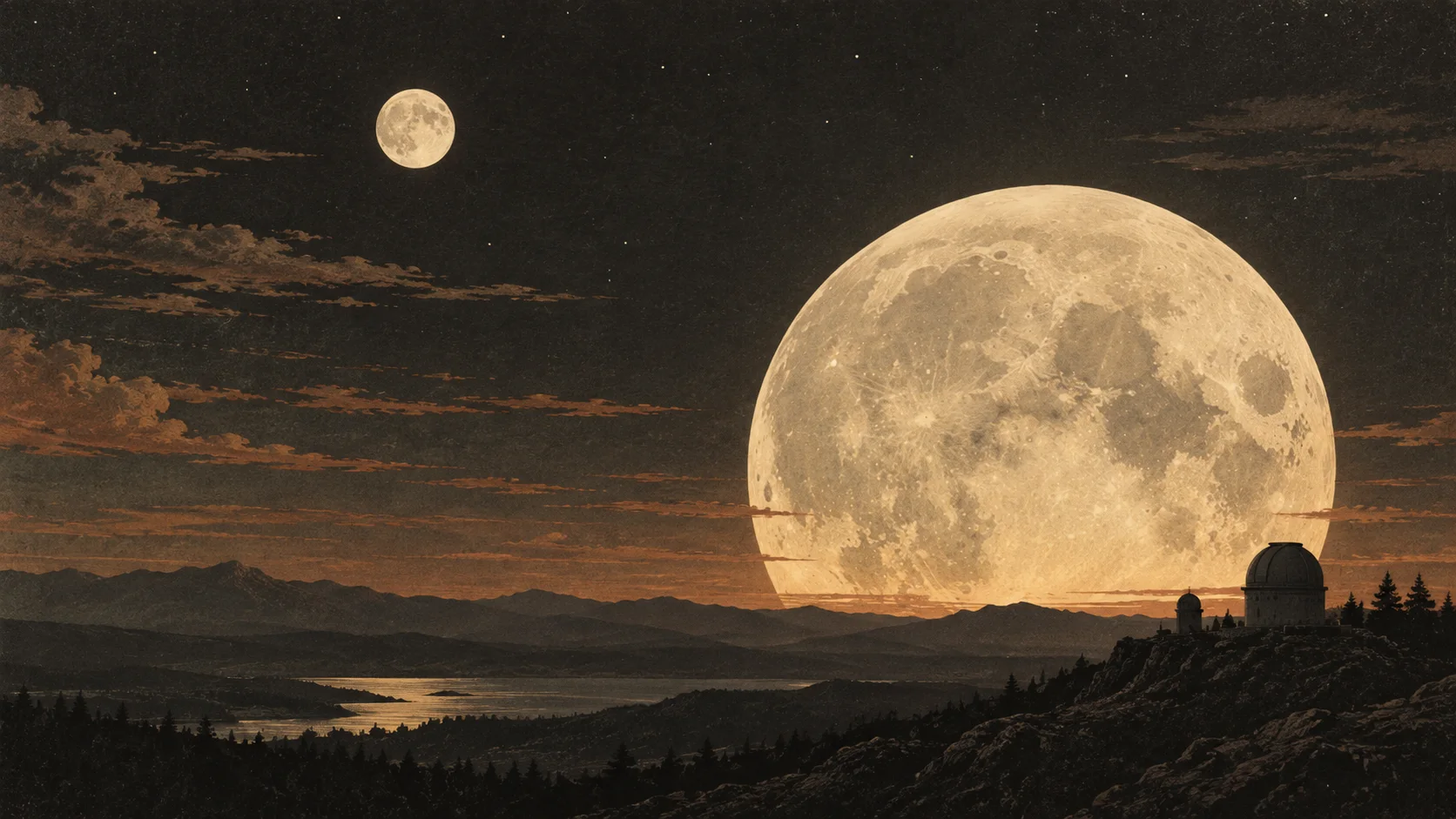
Streetlights fall behind. Houses slide away. The Moon stays in the window like it knows where you're going. It's one of the first sky mysteries children notice and one of the easiest adults learn to stop noticing. Let's make it strange again.
A local or observer-specific Moon would gain support if its measured direction changed with observer motion in a way incompatible with a distant shared object. The feeling of being followed is the clue; angular measurements are the evidence.
The argument being tested—not a claim that the theory has been verified.Your personal surveillance balloon.
Take the suspicion at face value for a moment. What if the image is near, or tailored to you? The everyday experience feels cooperative: change direction and the Moon seems to remain available. The local-Moon reading turns that persistence from a background fact into a feature somebody might have designed.
The ordinary account has a prediction too. Nearby landmarks move through your view much more than a distant object does. Measure both from two positions rather than remembering how it felt through a car window. A shared distant Moon and a nearby light won't produce the same angular changes.
This is a good conspiracy question because you don't need an institutional press release to begin. You need two safe observing spots, a fixed reference and a notebook. No driving while filming. The sky can wait until you've parked.
The scenery is giving the game away.
Parallax links apparent displacement to the observing baseline and distance. A short walk is a large change relative to a nearby tree, but a tiny change relative to the Moon. Our geometric interpretation is that the mismatch creates the following impression.
That does not mean the Moon never changes position. On longer time scales the sky changes, and widely separated observers can measure parallax. 'It follows my car' and 'its direction is fixed for everyone' are not the same observation.
A passenger-seat experiment only.
Pick a window frame, a nearby landmark and the Moon while somebody else handles the driving—or do the comparison on foot. Note which directions change quickly and which barely change.
Do not take a phone image with a tiny saturated dot as a precision angular measurement. The point of this test is the contrast in motion; a distance estimate needs a measured baseline, timing and uncertainty.
Nearby objects shift quickly as you move; the Moon's direction changes much less on the same journey.
A TEST, NOT A DARE.
Walk a short safe route. Compare a nearby pole against a distant building and the Moon. Write the expected order of apparent movement before you begin.
These are suggested exercises, not experiments we claim to have performed.
KEEP A PRIVATE FIELD NOTE ↗The Moon might not be following you. But following its angle is a much better evening than arguing with a memory of a road trip.
THE RECEIPTS / LINKS REVIEWED 25 SEP 2026
THE SOURCE SHELF.
Read the record, including its limits. A link to a claim documents what somebody says; it does not endorse it. Videos and social accounts open on their own sites—no embedded trackers or autoplay.
- Video / NASA Scientific Visualization StudioMoon Essentials: Parallax ↗
A labelled geometric visualization, not raw telescope footage.
- Explainer / NISTHow do you measure the distance to the Moon? ↗
Time-of-flight and astronomical distance measurement.