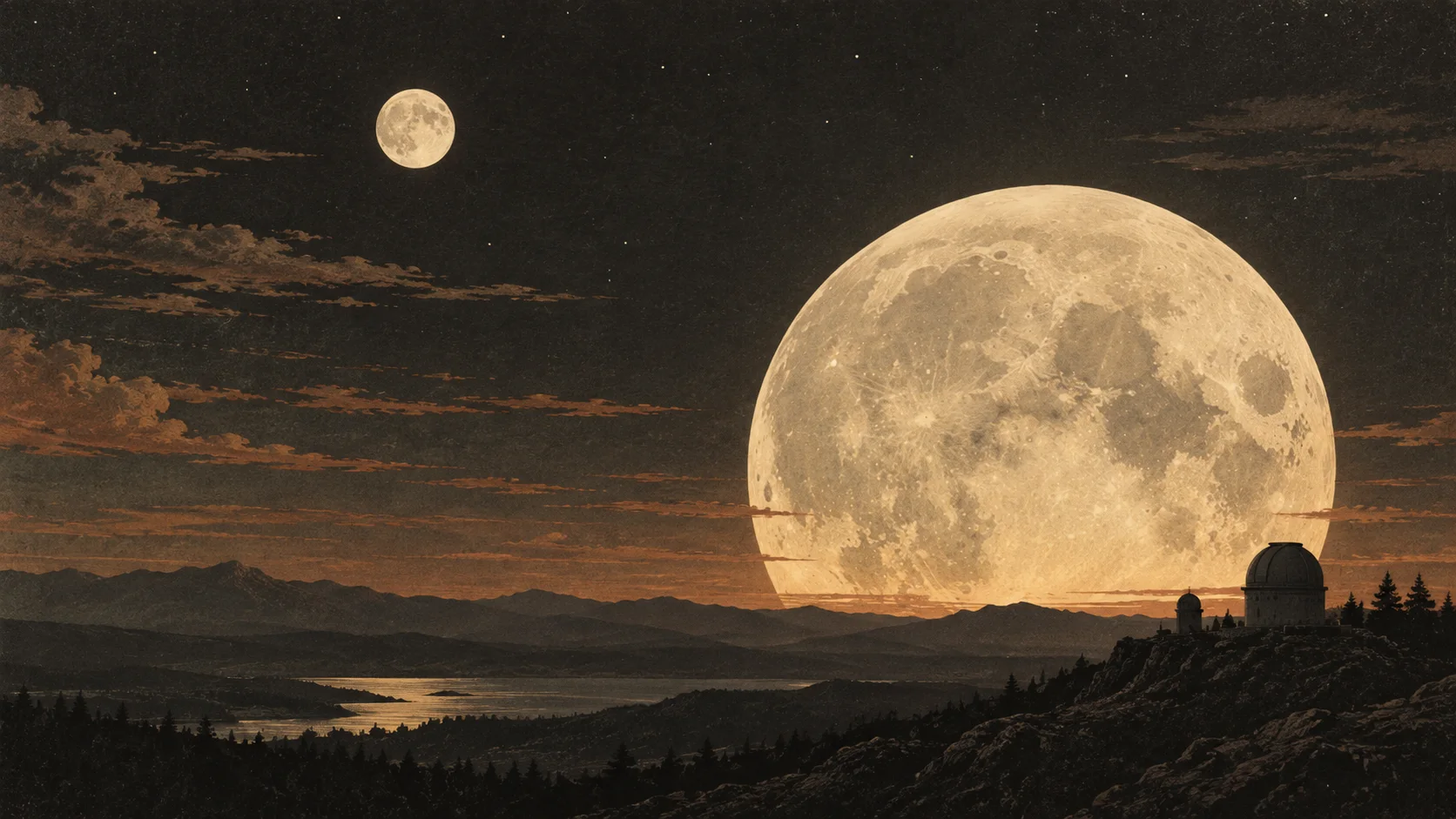
You know the moment: the Moon clears a roof and looks too big for the neighbourhood. Not a little bigger. Cinema-poster bigger. Then somebody explains that it hasn't really grown, which feels like being told your perfectly good astonishment has a clerical error.
A real enlargement claim wins if a fixed-scale record shows increased angular width beyond the expected geometry. A repeatable perceptual effect is also real—but it is evidence about seeing, not automatically an expanding or nearby Moon.
The argument being tested—not a claim that the theory has been verified.Your eyes would like to appeal.
The local-Moon suspicion gets its emotional force here. A disc that appears to change size as it rises feels less like a distant object and more like a light moving through your immediate surroundings. Before dismissing that intuition, preserve what it predicts: a measurable change in angular width.
Take the same camera, keep the same focal length and retain the uncropped files. A huge Moon behind a distant skyline and a tiny Moon in a wide-angle sky aren't a controlled comparison. They are two excellent pieces of art pretending to be one experiment.
NASA's own discussion acknowledges that the perceptual mechanism is not completely settled. That is an actual loose end, not proof of an alternative cosmology. The most compelling outcome may be that the camera stays sober while your visual system throws a rooftop party.
Your eyes are allowed to be dramatic.
NASA's explainer separates the Moon illusion from actual orbital size changes. It also acknowledges that there is no single fully satisfying explanation of the perceptual effect. We should not replace an internet myth with fake scientific certainty.
A dramatic moonrise and a same-scale camera measurement can disagree because they answer different questions: felt size versus recorded angular width.
Keep the ruler fixed.
NASA publishes paired rising and higher-Moon images illustrating matched horizontal diameters. Atmospheric refraction can squash the vertical dimension near the horizon; that is another reason to state which diameter is being measured.
Our repeatable version: keep focal length and crop scale unchanged, use the same night's Moon, and measure horizontal width. Do not compare two social-media photos with unknown lenses.
The impressive rise is real as an experience. It is not generally a giant increase in the Moon's horizontal angular size.
A TEST, NOT A DARE.
Photograph a low and higher Moon without changing zoom. Compare uncropped horizontal pixel diameters and note clouds, focus and any vertical flattening.
These are suggested exercises, not experiments we claim to have performed.
KEEP A PRIVATE FIELD NOTE ↗Let the moonrise be outrageous. Keep the ruler boring. Both records are worth having.
THE RECEIPTS / LINKS REVIEWED 25 SEP 2026
THE SOURCE SHELF.
Read the record, including its limits. A link to a claim documents what somebody says; it does not endorse it. Videos and social accounts open on their own sites—no embedded trackers or autoplay.
- Explainer / NASA Science / Preston DychesThe Moon illusion ↗
Distinguishes angular size from perception and acknowledges an unsettled perceptual explanation.
- Primary record / NASA SciencePhotographing the Moon illusion ↗
A same-scale image comparison and instructions for repeating it.
Open the original source-led case file for the evidence ledger, calculations and observation tools.
OPEN THE FIELD GUIDE ↗