Every so often the Moon gets a product launch. Supermoon. Rare spectacle. Biggest and brightest. The disc rises, the skyline photographs circulate, and suddenly a familiar satellite has been given a limited-edition treatment. The first conspiracy worth checking is the comparison baseline.
A manipulated-size claim needs fixed-scale images that contradict the predicted apparent size. A misleading promotional comparison is a different, easier-to-test claim: ask what ordinary Moon the headline is comparing against.
The argument being tested—not a claim that the theory has been verified.The Moon, now with premium packaging.
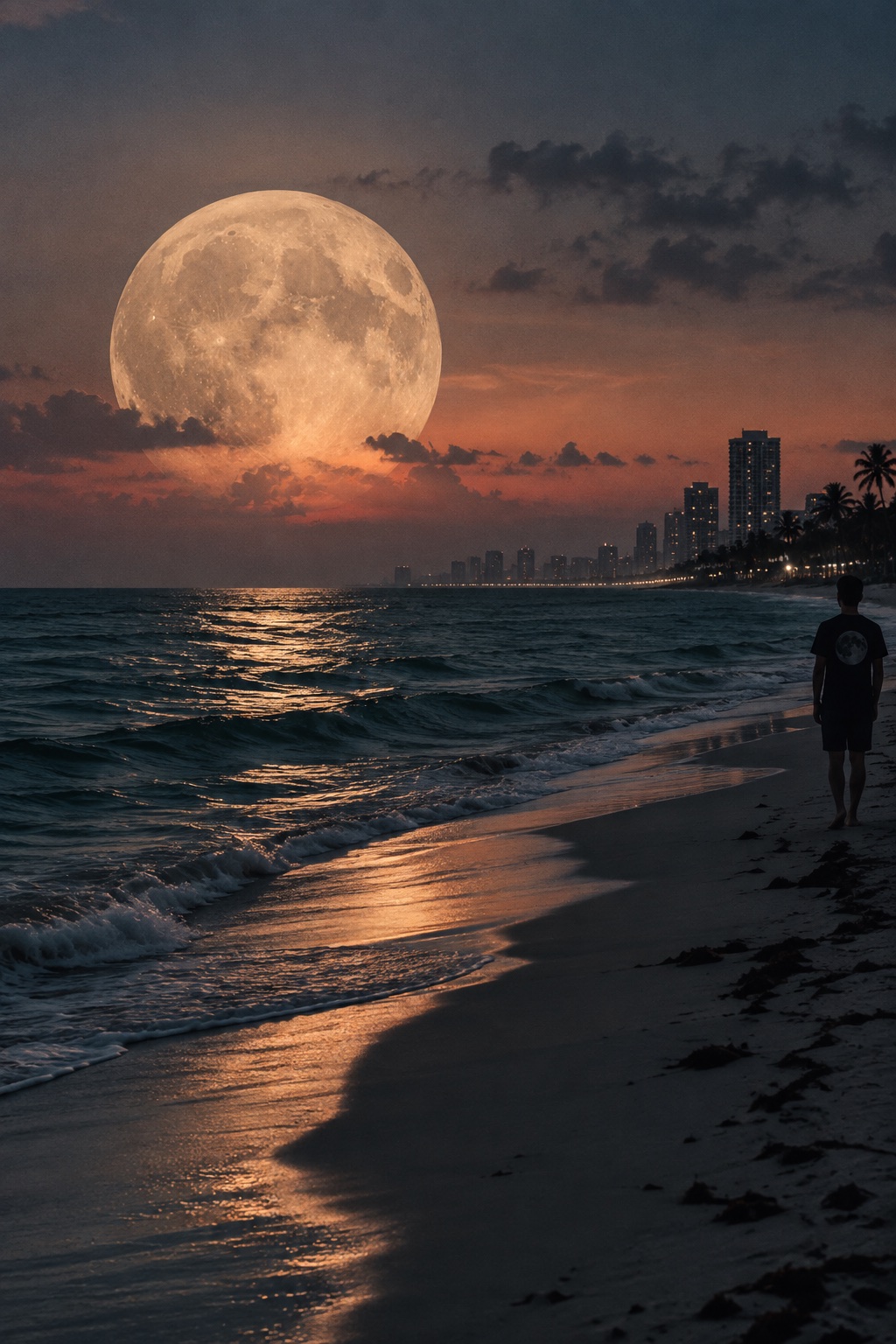
You don't need a projector to make a Moon look enormous in a photograph. Lens choice, distance from foreground buildings and framing can do an extraordinary amount of storytelling. That doesn't make the picture dishonest as art. It does make it a dubious ruler.
NASA's supermoon explanation distinguishes orbital changes from the impression of a huge horizon Moon. Its video is a useful companion, not a measurement of your particular night. Keep the categories separate: an actual size change, a perceptual effect and a photograph's composition can all contribute to the spectacle.
The local or variable-Moon theory deserves the same discipline. Same camera scale, original frames, stated date. If there is a discrepancy, quantify it. Otherwise the only thing demonstrated may be that the sky looks excellent when somebody gives it a campaign budget.
Compared with what?
NASA describes a supermoon as a full Moon near perigee in its elliptical orbit. A comparison with the farthest full Moon is not the same as a comparison with an average one.
When a headline gives a percentage, find its baseline before repeating it. Our interpretation is that the geometry is real while the emotional packaging can be extravagant.
The rise adds its own theatre.
The Moon illusion can amplify the experience of a low moonrise. The linked NASA Science video separates the orbital and perceptual effects rather than making either disappear.
A long-lens landscape image is also a composition choice. To compare actual lunar disc sizes across dates, keep focal length, scale and cropping fixed. Do not compare the Moon with a building of unknown distance.
Closer full Moons are larger in angular size. The headline's comparison baseline determines how spectacular the number sounds.
A TEST, NOT A DARE.
Save same-zoom, uncropped images across dates and label the Moon's distance for each. State whether your comparison is with average, closest or farthest.
These are suggested exercises, not experiments we claim to have performed.
KEEP A PRIVATE FIELD NOTE ↗Look up. Enjoy the launch. Read the small print on 'bigger.'
THE RECEIPTS / LINKS REVIEWED 25 SEP 2026
THE SOURCE SHELF.
Read the record, including its limits. A link to a claim documents what somebody says; it does not endorse it. Videos and social accounts open on their own sites—no embedded trackers or autoplay.
- Explainer / NASA ScienceSupermoons ↗
Perigee, apogee and the size/brightness comparison baseline.
- Video / NASA Science on YouTubeWhat is a Supermoon and a Moon Illusion? ↗
An explanatory video, not an observation proving a particular night's size.
- Primary record / NASA SciencePhotographing the Moon illusion ↗
A same-scale image comparison and instructions for repeating it.
Open the original source-led case file for the evidence ledger, calculations and observation tools.
OPEN THE FIELD GUIDE ↗