
A lunar module looks like the sort of machine that ought to leave a statement. Flames. Debris. A crater with an exclamation mark. Then you see the landing photographs and the surface seems suspiciously underwhelmed. The accusation writes itself: perhaps the engine never ran there.
The staging interpretation treats the apparently undramatic ground beneath the lander as evidence that an engine never operated there. That accusation becomes compelling if the actual thrust, touchdown conditions and soil require an excavation that the original record does not show.
The argument being tested—not a claim that the theory has been verified.The rocket that didn't leave a movie crater.
Start with the staging interpretation rather than waving it away: a prop lowered onto a set wouldn't blast a hole beneath itself. That gives the theory a prediction. But the genuine-landing account needs its own prediction too, based on the engine near touchdown and the surface it encountered.
Read the Apollo preliminary science report as mission-produced evidence, not an independent verdict. Ask what surface disturbance was reported and what conditions would produce it. A plume, displaced dust and an excavated crater are different observations; don't let one substitute for another.
If a defensible model demands a deep hole and the original record shows none, that's a discrepancy worth carrying forward. If the predicted effect is subtle, a missing Hollywood crater isn't much of a witness. This case lives at the nozzle and the ground, not in our memory of action films.
Which crater did you predict?
Apollo 11's preliminary science report contains surface and soil observations. It is mission-produced evidence, and it is the right scale of record to consult before insisting that a landing must excavate a particular hole.
Our challenge to the objection: specify thrust, altitude, duration and surface assumptions. A visual expectation borrowed from an explosion is not yet an engine-plume prediction.
A surface change needn't be a pit.
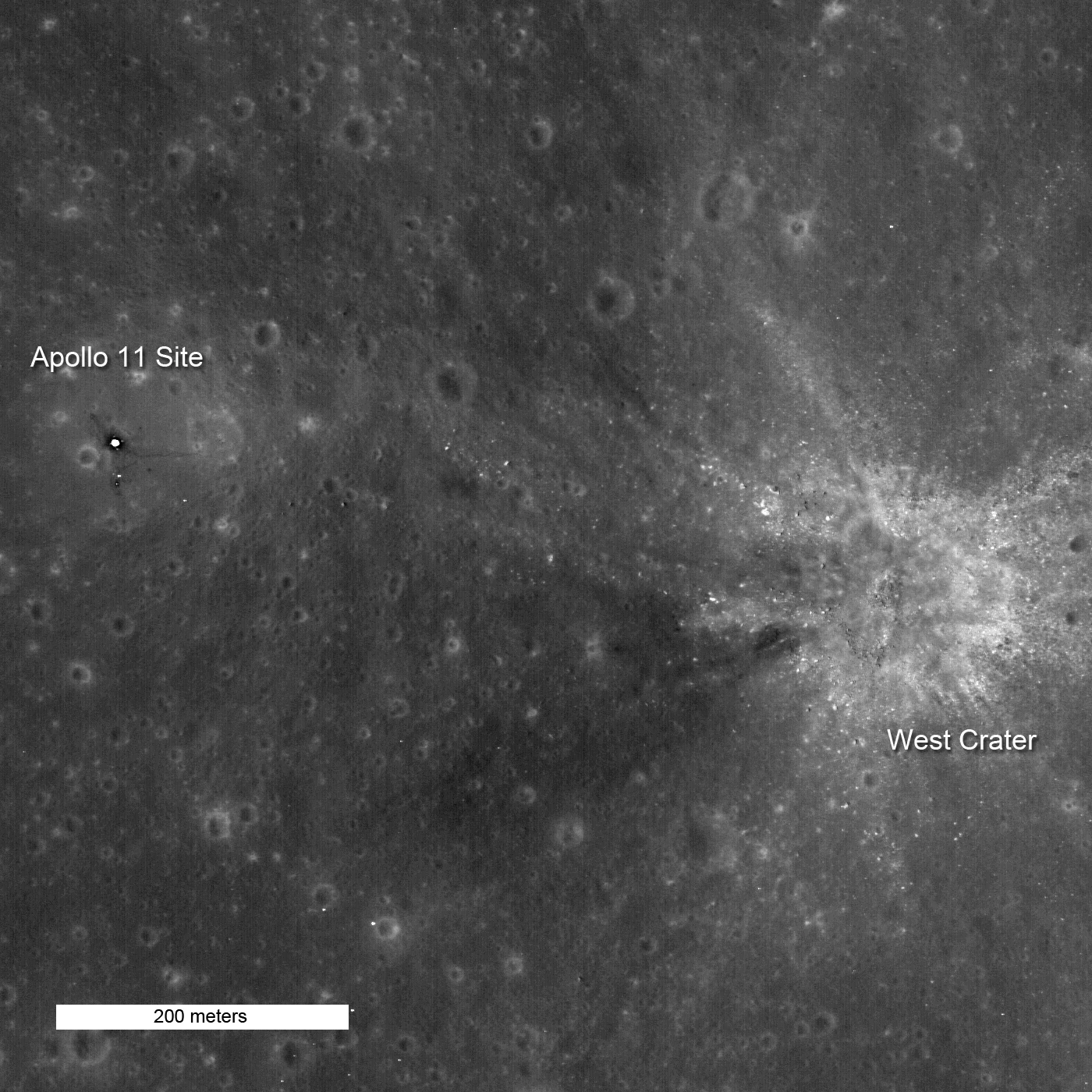
JAXA's Apollo 15 report identifies a potential brightened halo associated with the engine plume. It is a change in surface reflectivity, not a giant excavation or a resolved photograph of the engine.
That distinction matters in both directions. The halo supports a surface-disturbance account at that site, but it should not be promoted into a measurement of every Apollo landing's erosion.
The absence of a cartoon-sized crater is not a quantitative test of the lunar module's descent engine.
A TEST, NOT A DARE.
State the predicted feature and its minimum size before choosing an image. Compare only observations whose resolution could actually reveal that feature.
These are suggested exercises, not experiments we claim to have performed.
KEEP A PRIVATE FIELD NOTE ↗A rocket doesn't owe us spectacle. It does owe its account a physically consistent footprint.
THE RECEIPTS / LINKS REVIEWED 25 SEP 2026
THE SOURCE SHELF.
Read the record, including its limits. A link to a claim documents what somebody says; it does not endorse it. Videos and social accounts open on their own sites—no embedded trackers or autoplay.
- Primary record / NASA SP-214Apollo 11 Preliminary Science Report ↗
PDF: surface observations, soil mechanics and equipment reports. Mission-produced evidence.
- Primary record / JAXAKaguya observes the Apollo 15 halo ↗
Independent mission; 10-metre terrain-camera resolution. Not a close-up of astronauts or footprints.
Open the original source-led case file for the evidence ledger, calculations and observation tools.
OPEN THE FIELD GUIDE ↗